.jpg)
Share this article:
What A/B testing actually is
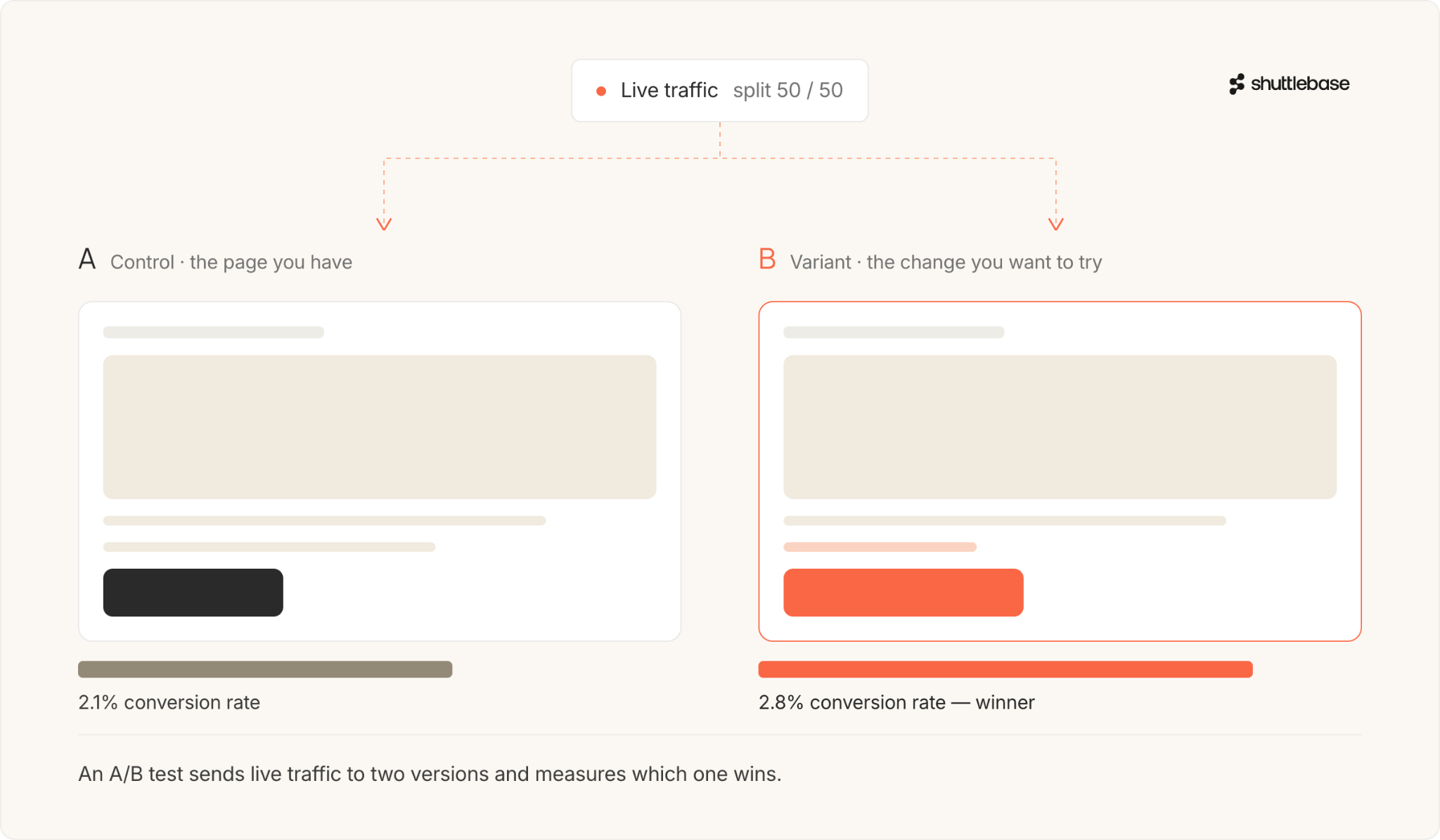
A/B testing, also known as split testing, is the process of showing different versions of the same experience to separate groups of visitors and measuring which version performs better. You show two or more versions of a page to live visitors, split the traffic between them, and measure which version performs better on a metric you chose in advance.
Version A is usually the page you already have, called the control. Version B is the change you want to try, called the variant. You can test more than two at once, which is sometimes called A/B/n testing. Traffic is divided into random groups, usually but not always an even split.
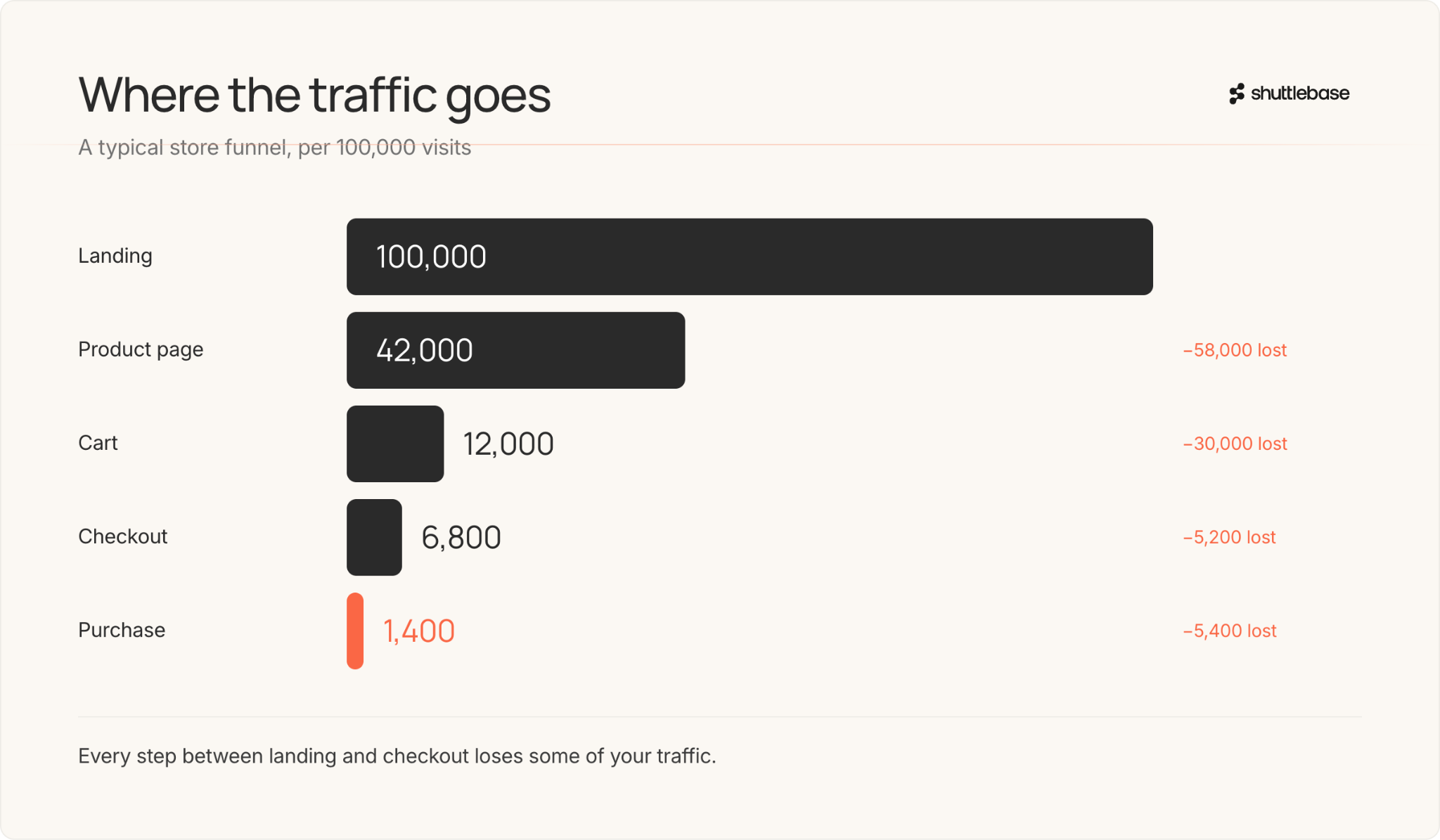
The metric you measure and look to improve is often the conversion rate. Conversion rate is the share of visitors who complete the action the site counts as success. For a store, that action is usually a purchase. If 100 visitors land on a page and two of them buy, the conversion rate is two percent.
A test runs until it has enough data to trust the result. That threshold is called statistical significance, which means the difference between the versions is large enough and stable enough that it probably isn't down to random chance. (We cover how that math works in our guide to statistical significance.) Once a version clears the line, the winner becomes the new default.
The whole method answers one question with one experiment. Does B beat A, yes or no?
What conversion rate optimization actually is
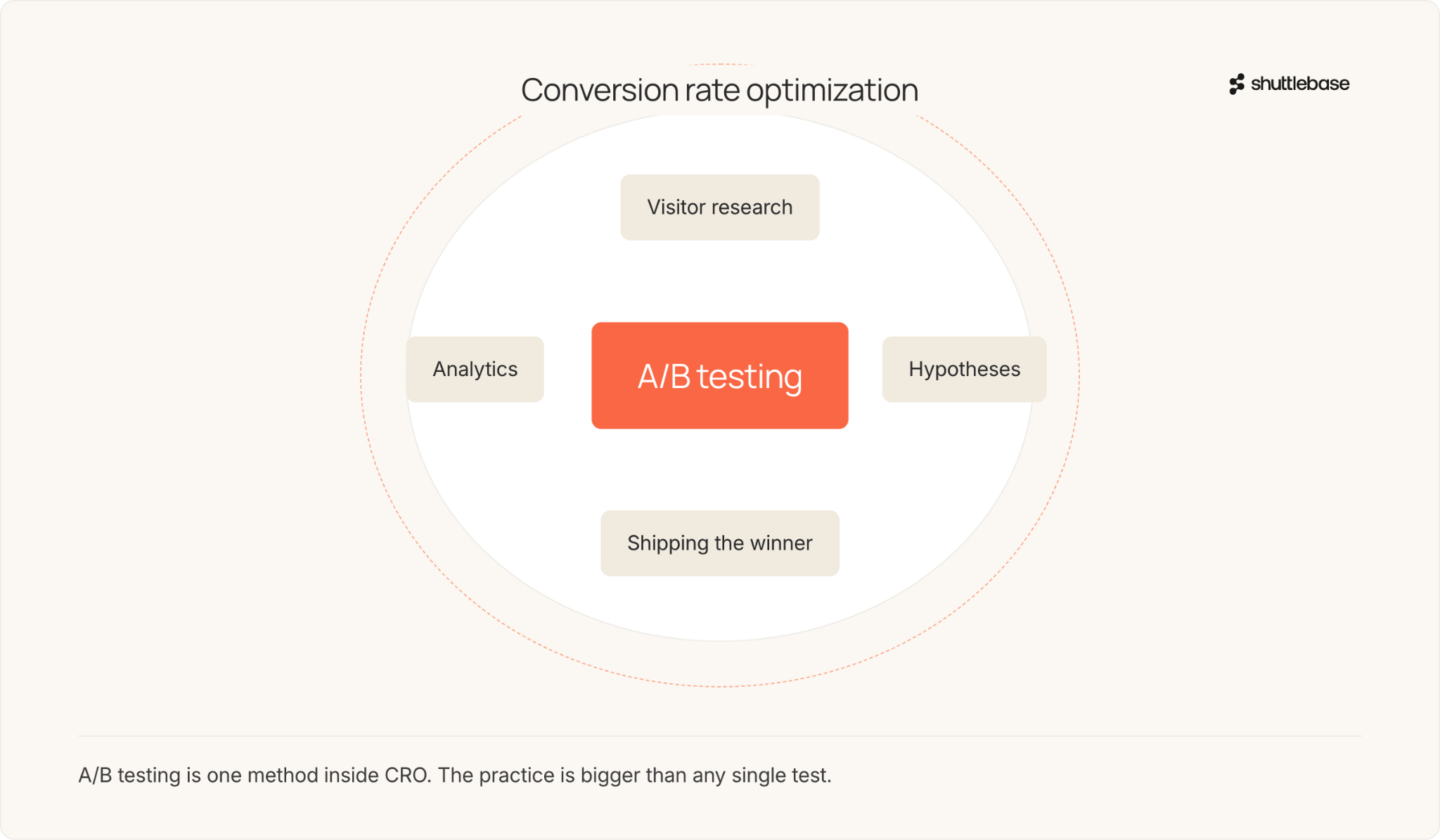
Conversion rate optimization, or CRO, is the practice of increasing the percentage of visitors who complete a specific action on your site. Unlike A/B testing, it is not a single test but a repeating process.
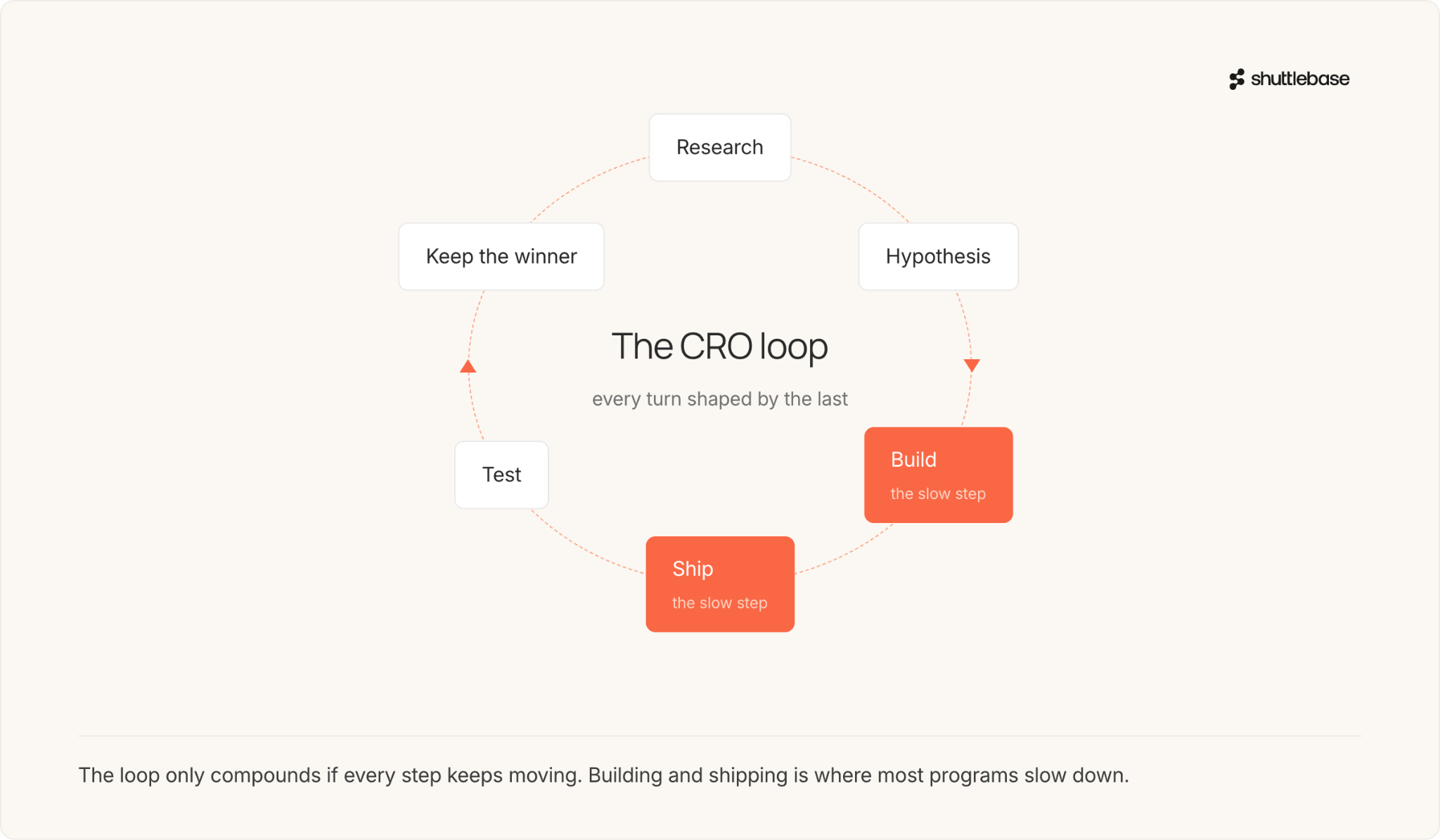
A CRO program usually runs in a loop:
- Study how visitors behave and where they leave.
- Form a hypothesis about what is costing you sales.
- Design and build the change.
- Test it, often with an A/B test.
- Keep the winner, learn from the result, and start again.
Here is an example of the CRO loop. The data shows many shoppers reach the cart and then leave. You hypothesize that surprise shipping costs are scaring them off, so you build a version that shows shipping earlier. You run it as an A/B test, and it wins. Now you keep the winner, and the result teaches you this store's shoppers care about cost clarity. That lesson points to your next test, maybe a clearer returns policy, and the loop starts over. The A/B test was one turn. CRO was the reason you knew which turn to take, and the reason you did not stop at one.
A/B testing vs. conversion rate optimization: the real difference
The clearest way to differentiate the two from one another is that A/B testing is a tactic and CRO is the practice that uses it.
Think of it the way a single experiment sits inside a larger research project. The experiment gives you one fact. The project is the ongoing work of asking better questions and building on what the last answer taught you. Run one A/B test, and you have run a test. Run tests continuously, each one shaped by the last, and you have a CRO program.
This changes what you should expect from your results. A test can win and still leave your revenue flat, because one win was never going to be enough on its own.
Why the difference costs you money
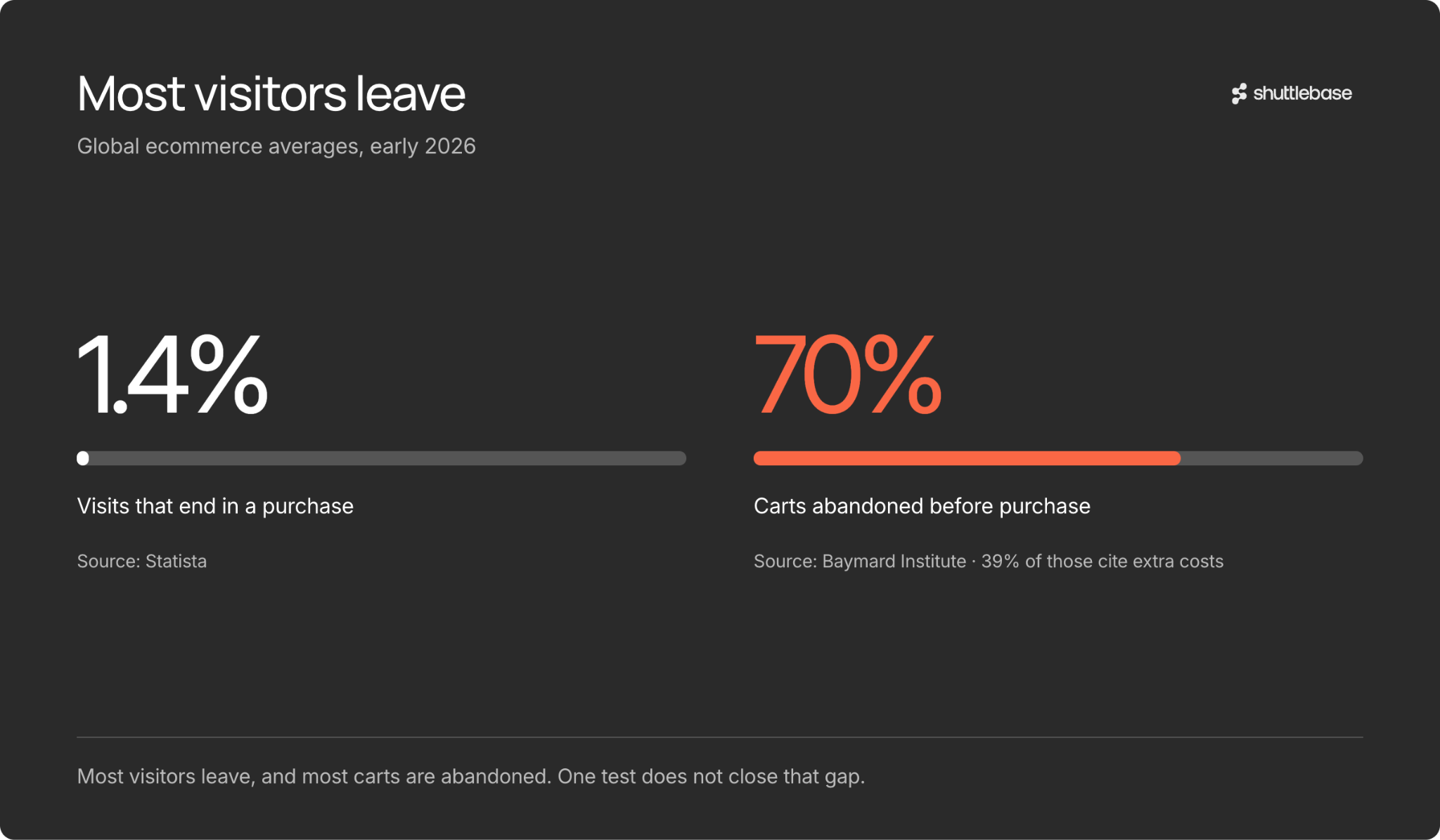
Across global ecommerce, about 1.4 percent of visits turned into a purchase in early 2026, according to Statista. That tells us most visitors leave websites without buying, leaving plenty of room between where a store is and where it could be.
Much of that loss happens at the checkout. Independent research from the Baymard Institute puts the average cart abandonment rate near 70 percent. About 39 percent of shoppers abandon their cart because extra costs like shipping and fees appear late in the process.
One A/B test can fix one leak, but it cannot fix the funnel. A funnel with that many gaps needs a program that keeps working through the places where buyers drop off.
Why testing programs stall
A CRO loop only pays off if it keeps moving. Every friction point needs a new hypothesis, a new version designed and built, and the engineering time to A/B test it. Then you wait for the test to reach significance, read the result, and start the next one. Do that once, and it is relatively easy, but do it every week, across dozens of pages, and it becomes a question of bandwidth
Teams don’t typically lack the ideas of what to test, but they fall shorting have the bandwidth and support from others teams to build and ship them. Each experiment needs a designer, a developer, and an analyst, and those are usually the same people with a hundred other tasks on their plate. So the backlog grows, the loop slows, and the program that was supposed to compound stalls instead. The advice to "just test more" rarely sticks, because running more tests was never the constraint. Building and shipping each one was.
Where AI changes the math
This is the part that has shifted recently. AI is now common in everyday business work. McKinsey's 2025 State of AI survey found that 88 percent of organizations use AI in at least one business function, up from 78 percent a year earlier.
In CRO, the loop's slowest steps are exactly the ones AI can handle. AI can read the behavior data, propose a hypothesis, generate the new version with design and copy, and A/B testing without waiting in a queue. The test still decides the winner. What changes is that the loop no longer stops between tests.
This is what autonomous CRO means. Instead of a person driving each step by hand, the AI runs the full loop and promotes the winners on its own. Shuttlebase is built to do just this.
The takeaway
A/B testing answers one question, did this change work? CRO turns that answer into the next question, then the next one, creating a system where each experiment informs what comes after it.
That matters because a single winning test can move a metric, but a continuous stream of informed wins starts to build a program that keeps finding, testing, and fixing the next opportunity.
When the work between experiments stops being the bottleneck, optimization can move from a series of projects to a continuous system of improvement.
.jpg)
.jpg)
.jpg)