.jpg)
Share this article:
Why A/B testing matters
Every ecommerce store loses sales somewhere between the product page and the confirmation screen. Shoppers browse and leave. They fill a cart and abandon it. They bounce before they ever add anything. A/B testing helps you figure out which changes will persuade more shoppers to finish what they came to your site to do.
Here's what A/B testing gives you:
- More revenue from the traffic you already have. Good traffic is expensive to acquire. Testing helps you convert more of what you're already paying for, and even a small improvement adds up when you multiply it across enough visitors.
- Lower bounce rates. People bounce for all kinds of reasons: too many choices, mismatched expectations, confusing navigation, jargon they don't understand. There's no universal fix, which is exactly why you test. The right variation surfaces what's causing the problem and keeps people on the page longer.
- A safe way to make changes. A full redesign is a gamble. You're risking your current conversion rate on the hope that the new version works better. Testing lets you make incremental changes and know whether they help before you commit to them sitewide.
- Decisions grounded in evidence, not instinct. Winning tests come from real movement on real metrics. Page conversions, demo requests, cart abandonment, click-through rate. There's no room for gut feel when the numbers are right in front of you.
- A foundation for bigger moves. Whether you're tweaking a CTA or rebuilding an entire page, data should drive the decision. And once the new version is live, you don't stop. You test the next thing, then the next.
Which parts of a site are worth testing
Your conversion funnel drives the business, so optimize anything that influences visitor behavior. This list isn't exhaustive, but it’s a starting point for what you could optimize.
Copy
1. Headlines and subheadlines. These set the first and last impression on your site. Keep them short, pointed, clear at a glance.
2. Body. State plainly what the visitor gets, and match the headline.
Design and layout
The way a page is laid out determines whether someone goes from landing to checkout or gets lost along the way. A button that's just a little harder to spot will cost you real money once you multiply it across enough visitors. And the thing about design is that nobody can predict how people will actually react to it, that’s why you have to test it.
Navigation
The most crucial element for user experience. Plan the structure and how pages link within it. It starts at the home page, the parent every page emerges from and links back to, and every click should land where intended.
Forms
Forms show how prospects reach you, and matter more inside a purchase funnel. No two forms serving different audiences are alike: short comprehensive forms suit some businesses, long ones improve lead quality elsewhere. Use form analysis to find the problem area.
CTA (call-to-action)
Whether visitors finish a purchase or complete a sign-up, test CTA copy, placement, size, and color scheme to see what converts best.
Social proof
Expert recommendations and reviews, celebrity and customer endorsements, testimonials, media mentions, awards, badges, certificates. It validates your claims. Testing shows whether to add it at all, then which kinds, how many, and where to place them.
Content depth
Some visitors read exhaustively; many skim. Which is yours? Create two versions of the same content, one substantially longer, and see which compels readers. Depth affects SEO, conversion rate, time on page, and bounce rate.
Choosing a statistical approach
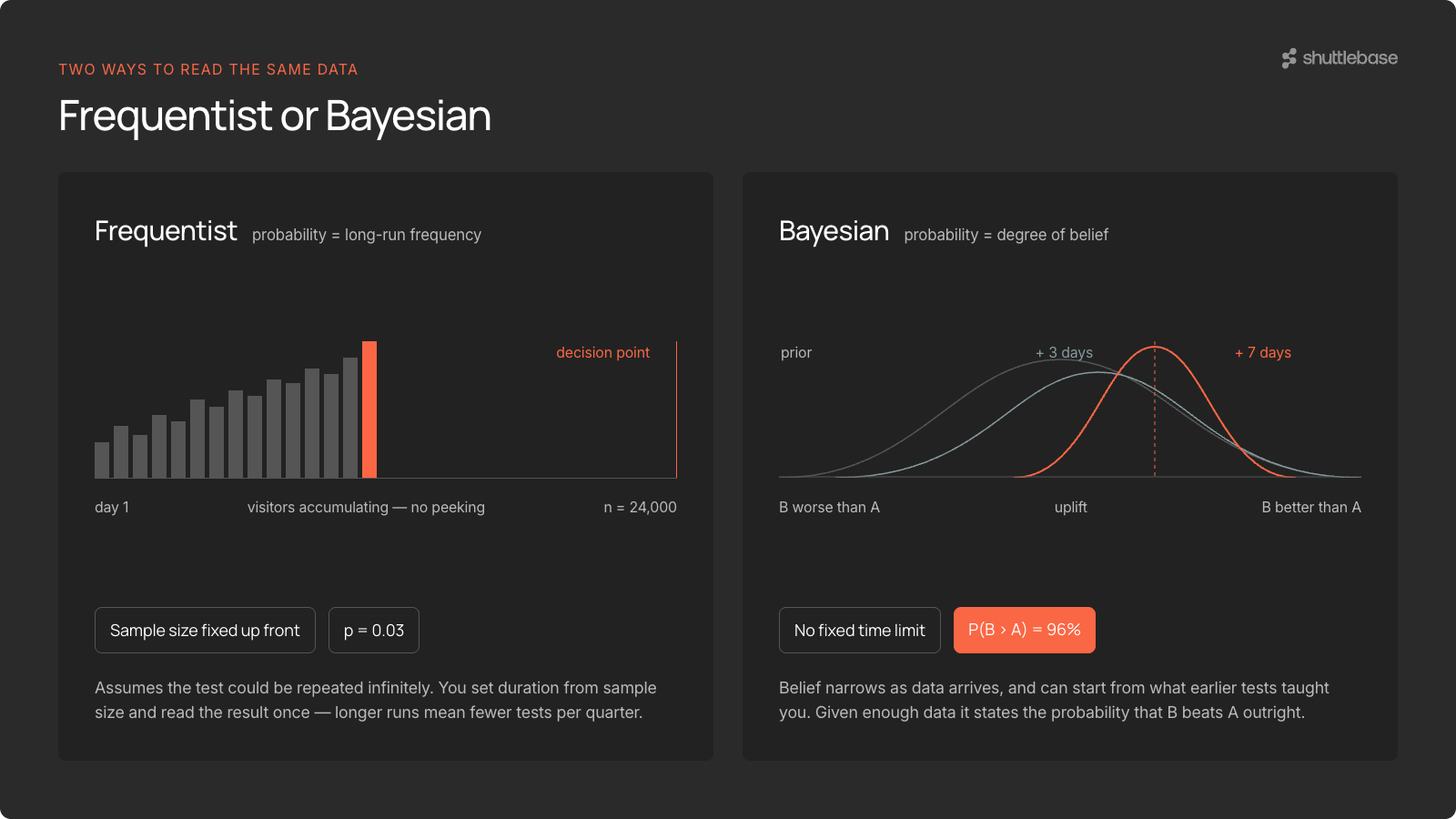
Two statistical approaches determine whether your test result is real: Frequentist and Bayesian. Most testing tools use one or the other, and understanding the difference helps you interpret what the numbers are actually telling you.
The Frequentist approach
Frequentist probability relates an event's probability to how often it occurs across many trials. It requires defining duration from sample size, and rests on the premise that any experiment can be repeated infinitely. That demands care on every test, since longer runs for the same visitors mean fewer tests per timeframe.
The Bayesian approach
Bayesian statistics is theory-based, expressing probability as a degree of belief. The more you know, the faster you predict the outcome. Probability isn't fixed, it shifts as information arrives, and your beliefs can build on previous test results. Given enough data, it tells you the probability that variation A converts lower than B or the control. No defined time limit, and no deep statistical knowledge needed.
The four testing methods
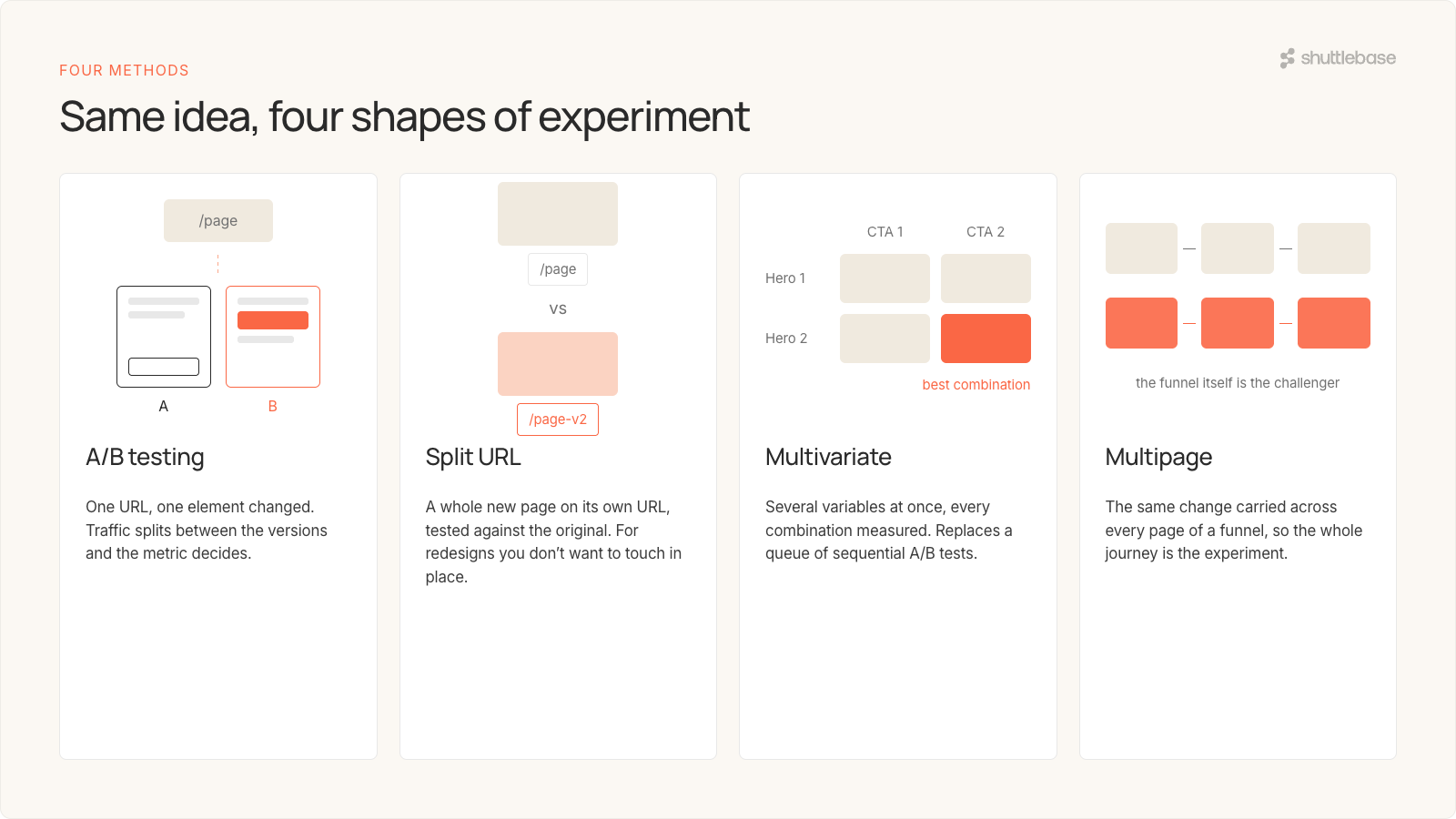
Four exist: A/B, Split URL, Multivariate and Multipage.
A/B testing
A/B testing is the process of showing different versions of the same experience to two groups of visitors and measuring which version performs better. One version acts as the baseline (the control), while the other introduces a specific change (the variation).
Split URL testing
Often confused with A/B testing and fundamentally different, an entirely new version of an existing URL is tested against it. Split URL suits significant design changes where you will not touch the original. Traffic splits between control URL and variation URL.
Multivariate testing (MVT)
MVT tests variations of multiple page variables at once to find the best combination across all different variants. Done properly it removes the need for sequential A/B tests with similar goals, saving time, money and effort.
Multipage testing
Tests changes to elements across several pages, in two ways. Create new versions of every page in your sales funnel, making the challenger the funnel itself.
Running an A/B test, step by step
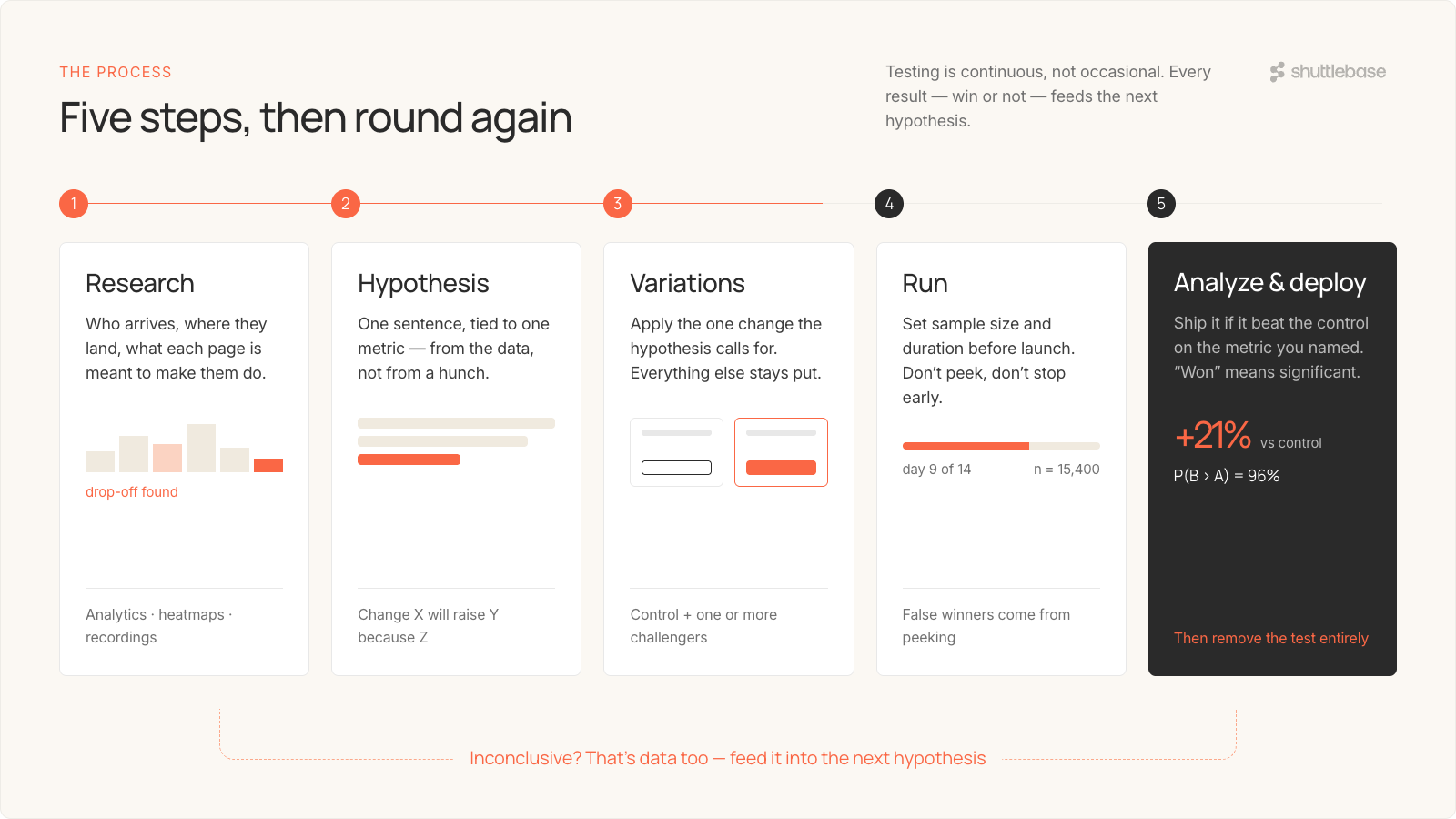
A/B testing is a systematic way to find what actually works on your website. As acquisition grows harder and more expensive, the experience your site gives your customer matters more. A structured program pinpoints the problem areas worth optimizing, and testing has shifted from an occasional activity to a continuous part of a defined CRO process.
Step 1: Research
Start by looking at how the site performs. Check how many visitors arrive, which pages bring them in, and what each page is supposed to get them to do. Pull this from your analytics for the numbers and heatmaps or session recordings for the behavior.
Step 2: Observe and form a hypothesis
Turn what you found into something you can test based on data, not just a guess. Title your hypothesis something along the lines of "moving the Add to Cart button above the fold will raise add-to-cart rate because shoppers won't have to scroll to find it." That format keeps every test tied to a specific metric.
Step 3: Create variations
Build the variation by taking your current page (the control) and applying the one change your hypothesis calls for. Keep everything else the same so you know the change moved the metric. You can run more than one variation against the control at once.
Step 4: Run the test
Before launching, calculate how many visitors you need and how long to run. Don't peek and stop early because the numbers look good, that's how false winners slip through. Use a sample size and duration calculator to set both up front.
Step 5: Analyze and deploy
Once the test has reached significance, deploy the variation if it beat the control on the metric you set out to move. "Won" means it hit statistical significance, not just that the number ticked up. If the result is inconclusive, it still tells you something, feed that into your next hypothesis and keep testing.
Conclusion
Now you should be equipped to plan your own A/B testing roadmap. Follow each step diligently and stay wary of the mistakes that come from not giving data the importance it deserves.
.jpg)
.jpg)