.jpg)
Share this article:
What is landing page optimization?
Landing page optimization is the practice of improving the elements of a page so that more of the people arriving on it take the action you want. It sits inside conversion rate optimization, the broader discipline of increasing the share of visitors who convert anywhere across your site, and narrows that discipline to one page and one audience.
What is a landing page?
A landing page is a standalone page built to guide a visitor toward a specific product, service, or offer. It is not your homepage. A homepage introduces your company to buyers, and a landing page speaks to one audience about one thing and asks for one action.
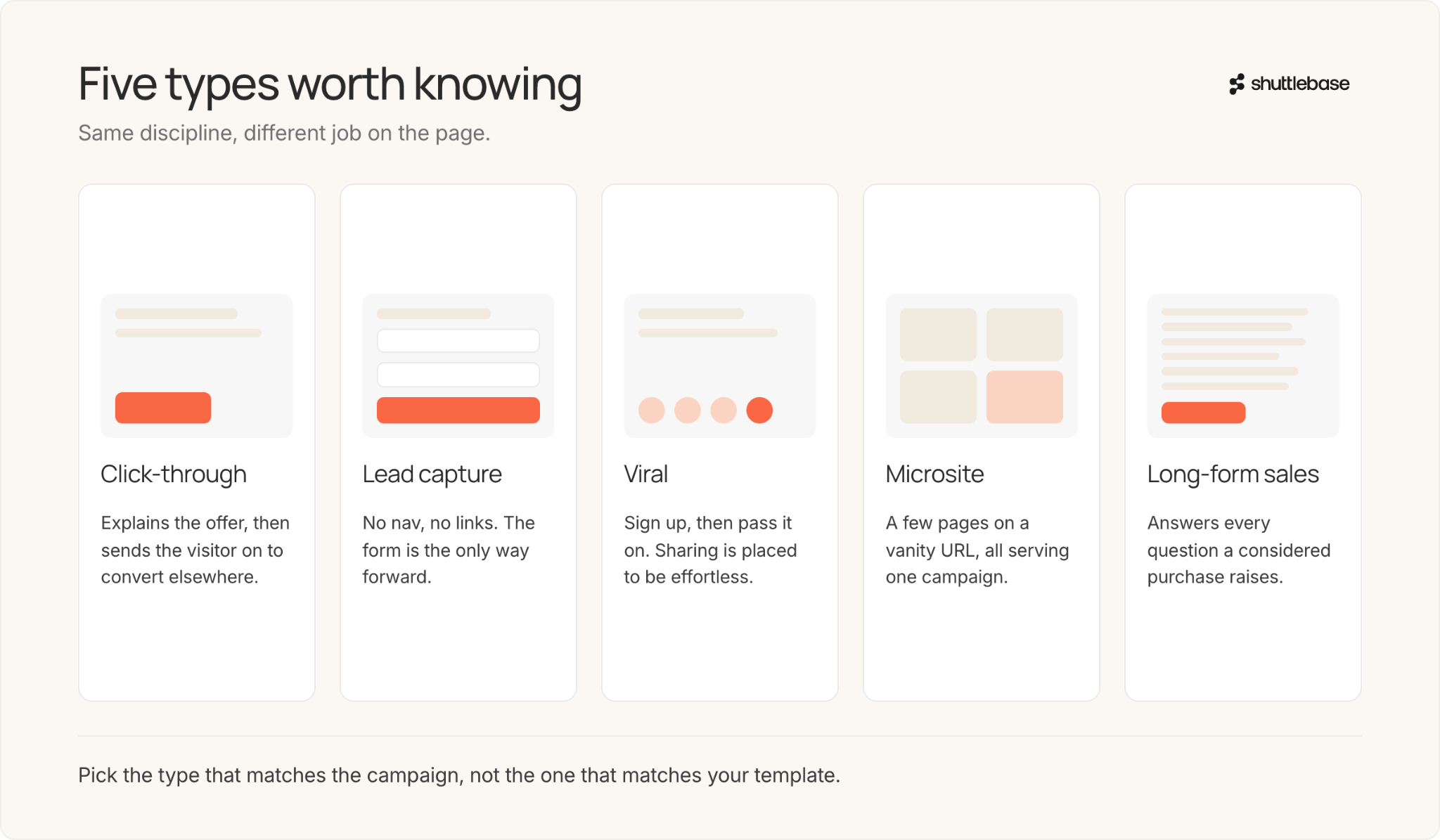
There are five types of landing pages worth knowing about.
1. Click-through landing pages
These exist to explain a product or service and its advantages, then move the visitor onward to complete the transaction elsewhere. The conversion itself happens on the next page.
2. Lead capture landing pages
Also called squeeze pages, these collect visitor information so that sales and marketing have prospects to work with. They deliberately remove exit paths, no navigation, no internal or external links, so the only thing a visitor can act on is the call to action.
3. Viral landing pages
The goal here is word-of-mouth. The page encourages a visitor to sign up and then to pass the offer to people they know, usually with social sharing icons placed to make that effortless.
4. Microsites
A microsite is a small supplementary site living on its own vanity URL. It runs to more than a single page but still counts as a landing page in purpose, because it exists to serve one campaign.
5. Long-form sales landing pages
When a purchase is considered, the page must answer every question a prospect might raise, remove the barriers between them and a purchase, and communicate the full set of benefits.
How to get started with landing page optimization
Optimize for different traffic sources
Prospects do not behave the same way depending on where they came from. Someone arriving from a paid search ad was actively looking for a solution and someone arriving from a social ad was interrupted mid-scroll. Those two people need different pages, and building one page for each source almost always beats forcing both through the same experience.
Work on the on-page elements
Value propositions, form fields, and the overall user experience all need continuous attention, and social proof needs to be present to give the page credibility it cannot claim for itself.
Landing page optimization checklist
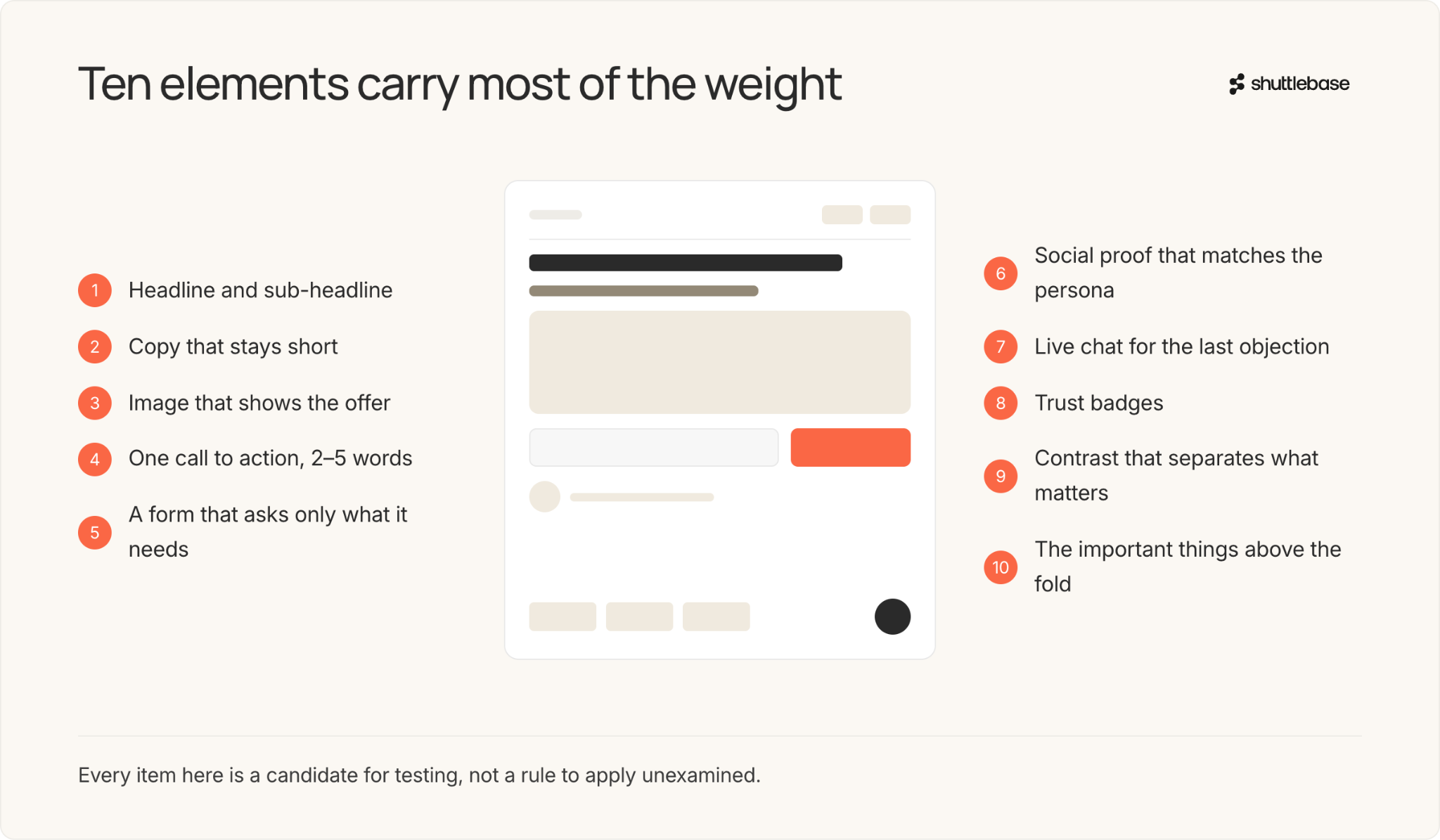
The objective is a hyper-focused experience built around a single conversion goal. Ten elements carry most of the weight.
1. Headline and sub-headline. These establish the connection with a prospect and do the persuading. Relevance and catchiness both matter; a headline that is clever but unrelated to the ad that delivered the click will lose the visitor.
2. Copy. Keep it clear, concise, and to the point. Bullet points break key aspects into digestible units.
3. Image. Visuals are among the first things visitors register. Use them to illustrate what you offer, set the tone, and hold attention.
4. Call to action. Create urgency, use action-packed words, and keep it to two to five, or choose a color combination that makes the button stand out.
5. Forms. Place the form thoughtfully on the page, keep it simple and concise, and ask only for relevant and necessary information. The shorter the ask, the more likely a prospect is to finish it.
6. Social proof. Testimonials and customer logos both work, but the proof has to match the persona. A landing page aimed at finance professionals needs testimonials from finance professionals. Amazon's product pages, built around customer reviews, are the most familiar example of proof at scale.
7. Live chat. According to an eMarketer study, 63% of people who engage with live chat are more likely to return to a site and 62% are more likely to buy. Chat moves customers down the funnel faster by answering the objection that would otherwise end the visit.
8. Trust badges. Security labels reinforce that the page is authentic. Alongside them, testimonials, media coverage, and social mentions all build reputation and credibility.
9. Color contrast. Use contrast in both color and clarity to separate what matters from what surrounds it.
10. Above the fold. Keep your most important elements visible before a visitor has to scroll.
None of this is one-size-fits-all. Every item here is a candidate for analysis and testing, not a rule to apply unexamined.
Landing page optimization best practices
1. Present hard-to-resist offers. Aesthetics get you attention; the offer gets you the conversion. What do they get for converting right here, right now? What do they risk losing out on if they don’t?
2. Decrease page load time. HubSpot reports that a one-second delay costs roughly 7% of conversions and 11% of page views. Slowness reads as dissatisfaction before a visitor has even seen anything you wrote.
3. Keep the visitor's journey in mind. Segment incoming traffic by stage. Visitors in the awareness stage are still diagnosing a problem. Those in the consideration stage are looking for a solution. Those in the decision stage are ready to convert. Meet each where they are rather than where you would prefer they were.
4. Create a seamless experience. Show people what you advertised. Use the same words across the landing page, paid ads, social posts, blog calls to action, and emails. Consistency is what makes the journey feel like one journey.
5. Use urgency and scarcity. Both are established principles of persuasion, and both work by creating a fear of missing out.
6. Pay attention to landing page SEO. Search is the secret weapon for ranking a landing page higher. Add relevant keywords to the page content, the meta title, and the meta description. The closer those keywords sit to what visitors are actually searching, the better the page ranks.
What are some landing page metrics you should track?
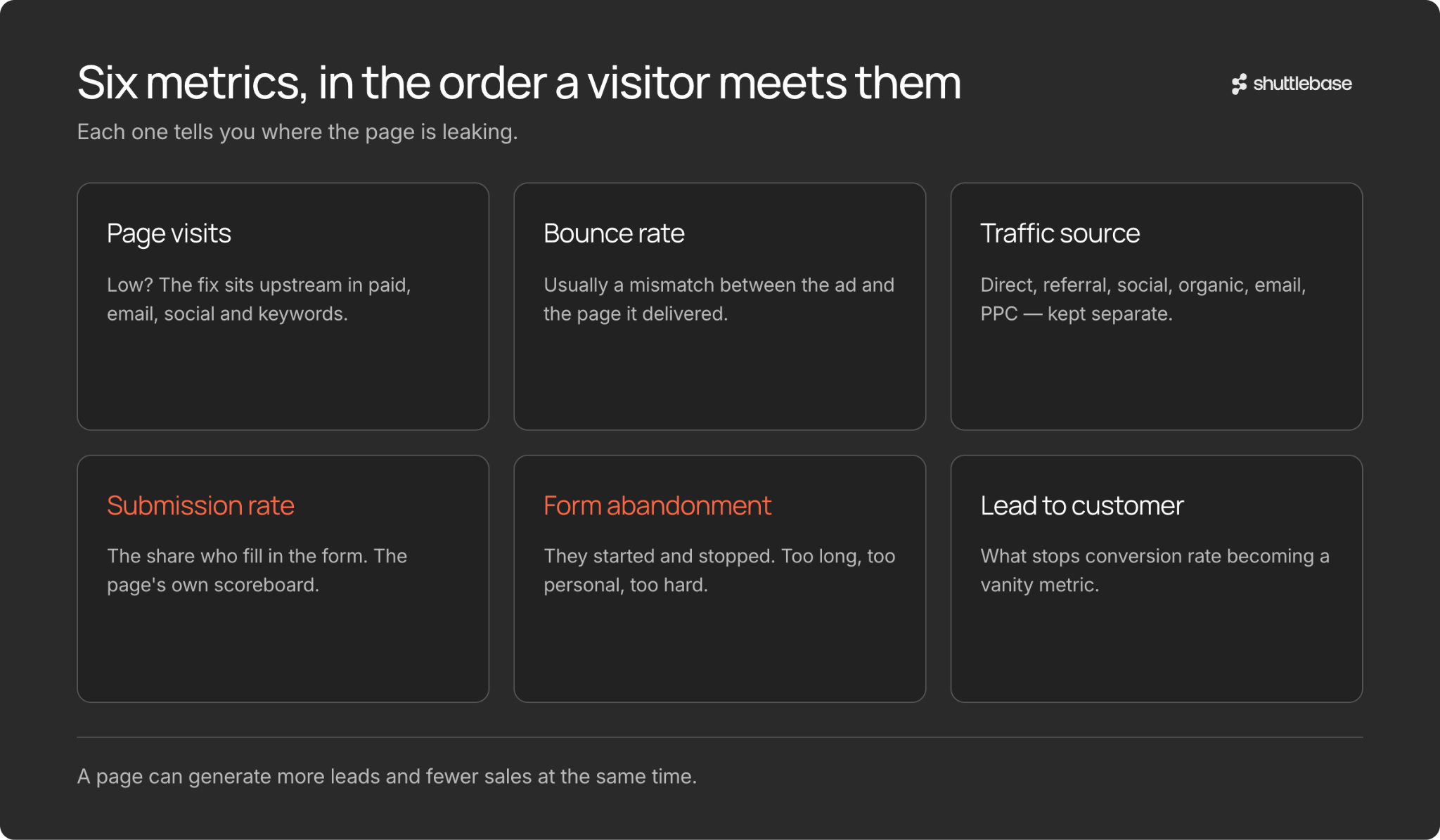
1. Page visits. The count of visitors over a period. More visitors means more opportunities to convert, and if the number is low, the fix sits upstream: refine the paid strategy, use email and social to drive traffic, and revisit your keywords.
2. Bounce rate. The percentage of visitors who leave without going any further. Causes include content misaligned with the ad, copy that fails to compel, poor visual hierarchy, or, occasionally, visitors who found exactly what they needed and left satisfied.
3. Traffic source. Knowing which sources send converting visitors tells you where to spend. Six categories are worth separating: direct traffic, where someone typed the URL; referral traffic, from a link on another site; social media traffic; organic traffic from search queries; email traffic, from a link or CTA in a message; and PPC traffic from a paid ad.
4. Submission rate. The percentage of visitors who fill in and submit the form. This is the page's own scoreboard. It shows how well the page is doing its job, separate from traffic quality or what happens after the lead comes in.
5. Form abandonment. The percentage of visitors who started filling in the form but didn't finish. When this number is high, the form is usually too long, asks for too much personal information, or is too difficult to complete on the device they're using.
5. Lead-to-customer percentage. The share of leads who become paying customers. Tracking it keeps conversion rate from becoming a vanity metric, a page can generate more leads and fewer sales at the same time.
Why should you A/B test landing pages?
What persuaded one audience won't automatically work for yours, and the only way to know is to test. A/B testing turns educated guesses into decisions you can trust. Start with one element: run your current version against a single change, split live traffic between them, and let the results pick the winner. It's also the safest way to improve a page that's already converting, since changing one thing at a time protects what's working while you look for better. Do it continuously and each test feeds the next.
What are the common landing page optimization mistakes?
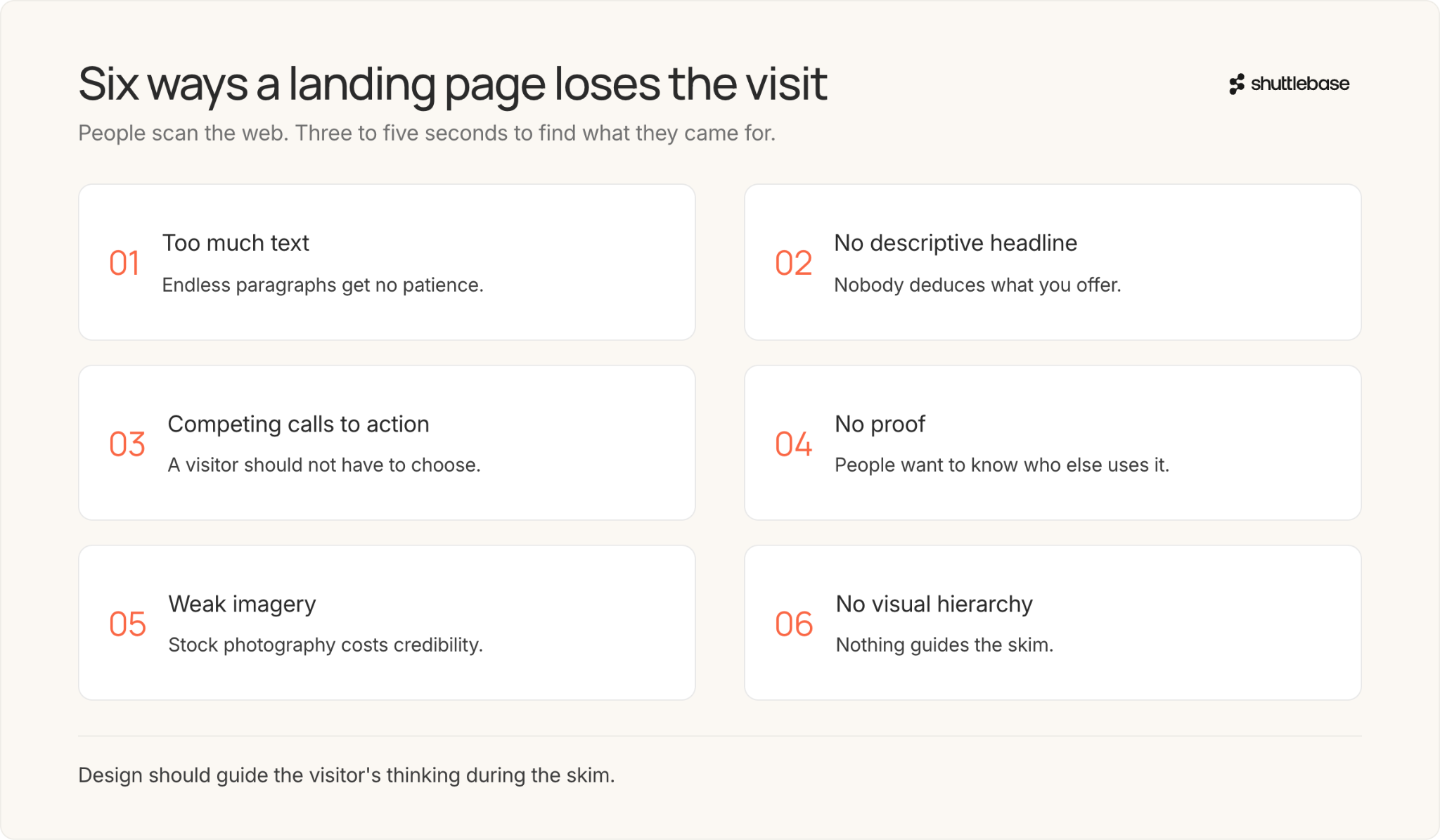
Mistake 1: Too much text. People scan the web; they do not read it. Endless paragraphs get no patience. If a visitor cannot find what they came for in three to five seconds, they leave. Keep text minimal, graphics simple, and imagery impactful.
Mistake 2: No descriptive headline. Nobody will spend minutes deducing what you offer. Headlines should be big, bold, and descriptive, because they're what stick in a visitor's mind for the rest of the visit.
Mistake 3: No single, prominent call to action. Too many calls to action create confusion, and you shouldn't make a visitor choose where to go next.
Mistake 4: No social proof or ROI proof. People want to know who else uses a product before they commit. Testimonials, company logos, customer photos, and case studies all work.
Mistake 5: Weak imagery. Stock photography reads as cheesy and costs credibility.
Mistake 6: No visual hierarchy. Design should guide the visitor's thinking during the skim, and font size, bold text, and image size are the instruments.
Your landing pages either convert or they don't, and the difference usually comes down to a handful of fixable problems. If you're spending money driving traffic to pages that aren't pulling their weight, we can help you find what's leaking and start testing fixes. Book a demo to learn more.
Frequently asked questions
How do you optimize a landing page? By changing elements and measuring the result. Test the headline, the copy, the images, and the CTA buttons, and keep what raises conversions.
Are landing pages good for SEO? Optimizing the user experience is a legitimate SEO benefit in itself. Over the long run, though, landing pages tend not to help: they are frequently orphan pages with few internal or external links pointing at them.
Do landing pages still work? Yes. They remain highly efficient for PPC campaigns in particular, because a page customized for one target audience converts far better than a general one.
What is a good conversion rate for a landing page? There is no single answer, since it depends heavily on industry. Conventionally, 2–5% is considered good.
.jpg)
.jpg)
.jpg)