Share this article:
Key Takeaways
- AI is removing the production bottleneck in conversion rate optimization (CRO). Design, copy, development, QA, and analysis that once took weeks can now be completed in hours.
- Autonomous CRO platforms can now handle experimentation end to end. They can identify conversion opportunities, generate working variants, QA changes, launch experiments, and surface results with less manual production work.
- As experiment generation gets easier, judgment becomes more valuable. The critical questions shift from “Can we build this?” to “Should we test this?” and “Is it safe, relevant, and worth testing?”
- Faster experimentation creates more opportunities to compound conversion gains. Removing production constraints allows teams to run more experiments, learn faster, and build on successful changes over time.
- The CRO team of 2027 will spend less time managing production and more time making decisions. AI handles more of the execution while humans provide the strategic direction, oversight, and judgment.
We Have All Lived This
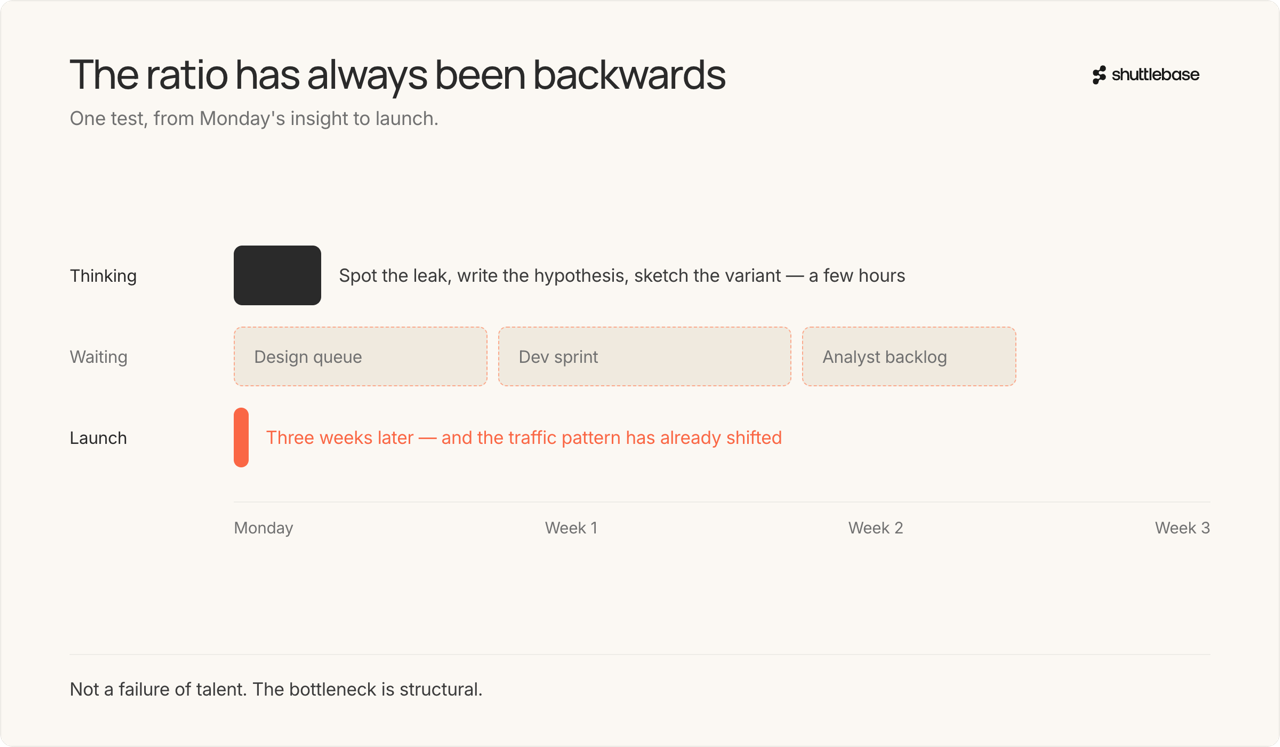
The biggest problem with experimentation is everything that happens between identifying an opportunity and actually testing it. You find a leaky checkout flow on a Monday. You write up the hypothesis, sketch the variant, and drop it into the backlog. Then you wait. The designer has other priorities, the developer is mid-sprint, and the analyst is buried in a quarterly report. Three weeks later your test finally launches, and by then the traffic pattern has shifted and you need a longer run. This is not a failure of talent. Everyone on that chain is good at their job. The bottleneck is structural. The work of figuring out what to test takes hours. The work of getting it built, shipped, and measured takes weeks. That ratio has always been backwards.
The Generation Problem Is Disappearing
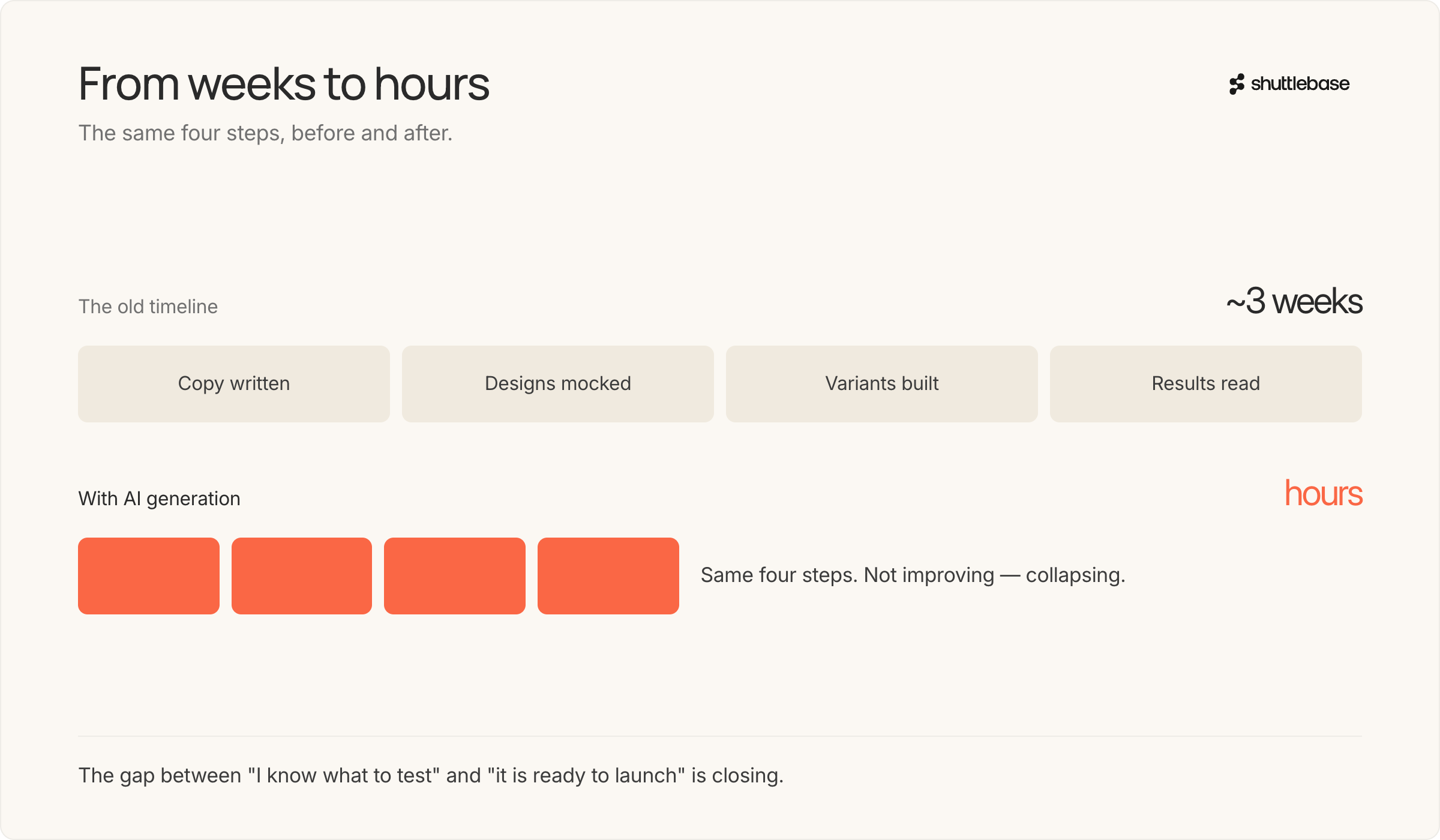
Using AI in experimentation has changed drastically in the last year. Claude Design, which launched in April 2026, can generate a dozen landing page directions in minutes from a text prompt. Vercel's v0 produces code-ready UI components from natural language. Tools like Shuttlebase now surface conversion insights that used to take an analyst days to uncover. The production steps that used to eat most of your testing timeline - getting copy written, getting designs mocked up, getting variants built, getting results interpreted - are collapsing. Not improving. Collapsing. The gap between "I know what to test" and "it is ready to launch" is shrinking from weeks to hours.
Autonomous Platforms Are Taking It Even Further
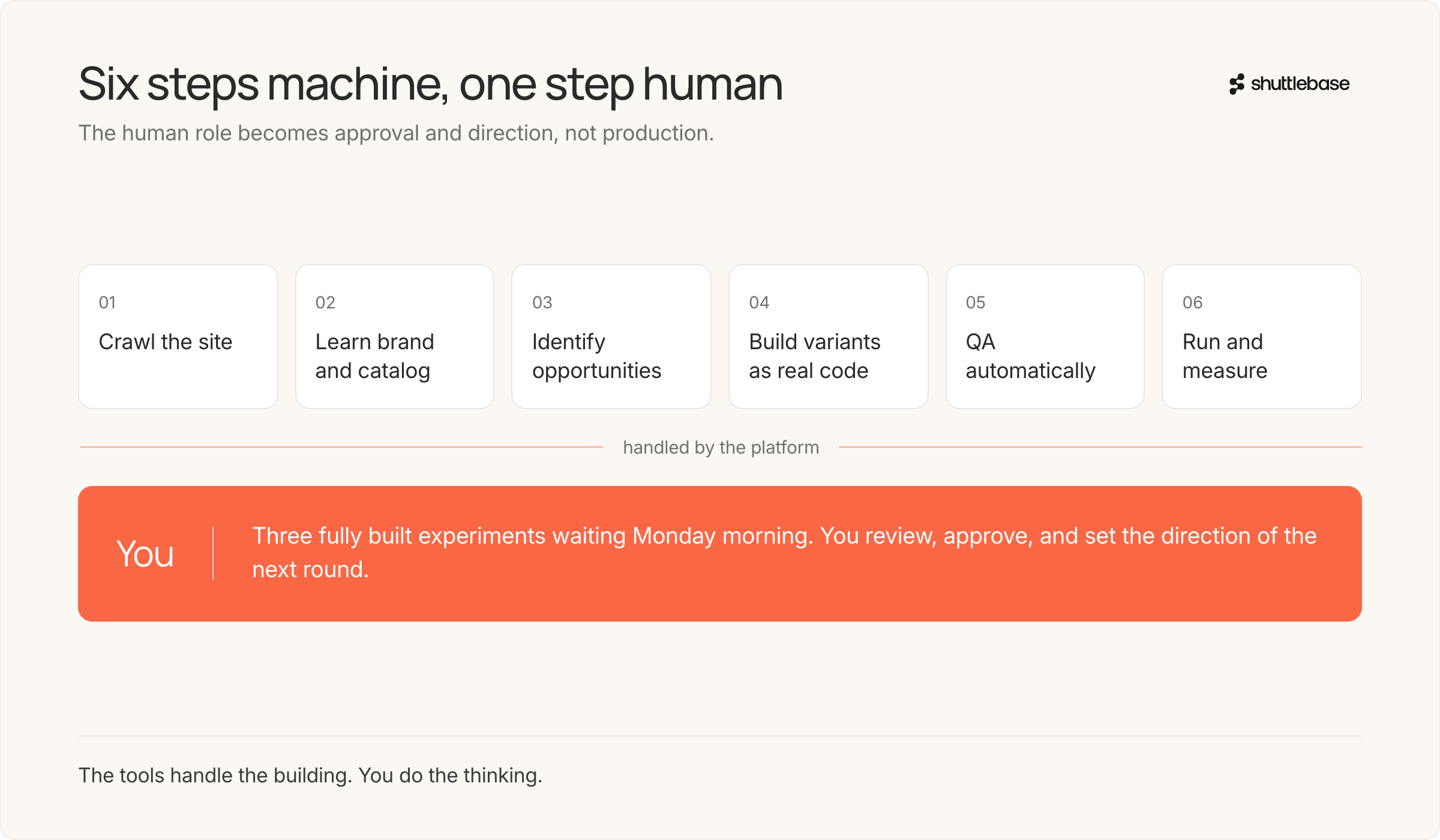
Autonomous CRO platforms can now crawl your site, learn your brand and catalog, identify testing opportunities, build working variants as real code, QA them automatically, run the test with proper statistical methodology, and surface the results. The human role becomes approval and strategic direction, not production. Imagine opening your dashboard on a Monday morning and finding three fully built experiments waiting for your review, each one targeting a real gap in your funnel, each one already QA'd and ready to launch the moment you say go. That is not a hypothetical. That is the direction the category is moving right now.
The Job Gets Better, Not Smaller
When you strip away the production bottleneck, what remains is the work you actually got into this field to do, which is understanding your customers. Figuring out why they hesitate, what motivates them, where the funnel actually breaks and why. Setting the strategic priorities that determine which experiments matter most. The CRO professional of 2027 is not a project manager chasing a test through four departments. They are a strategist.
The Burden Flips
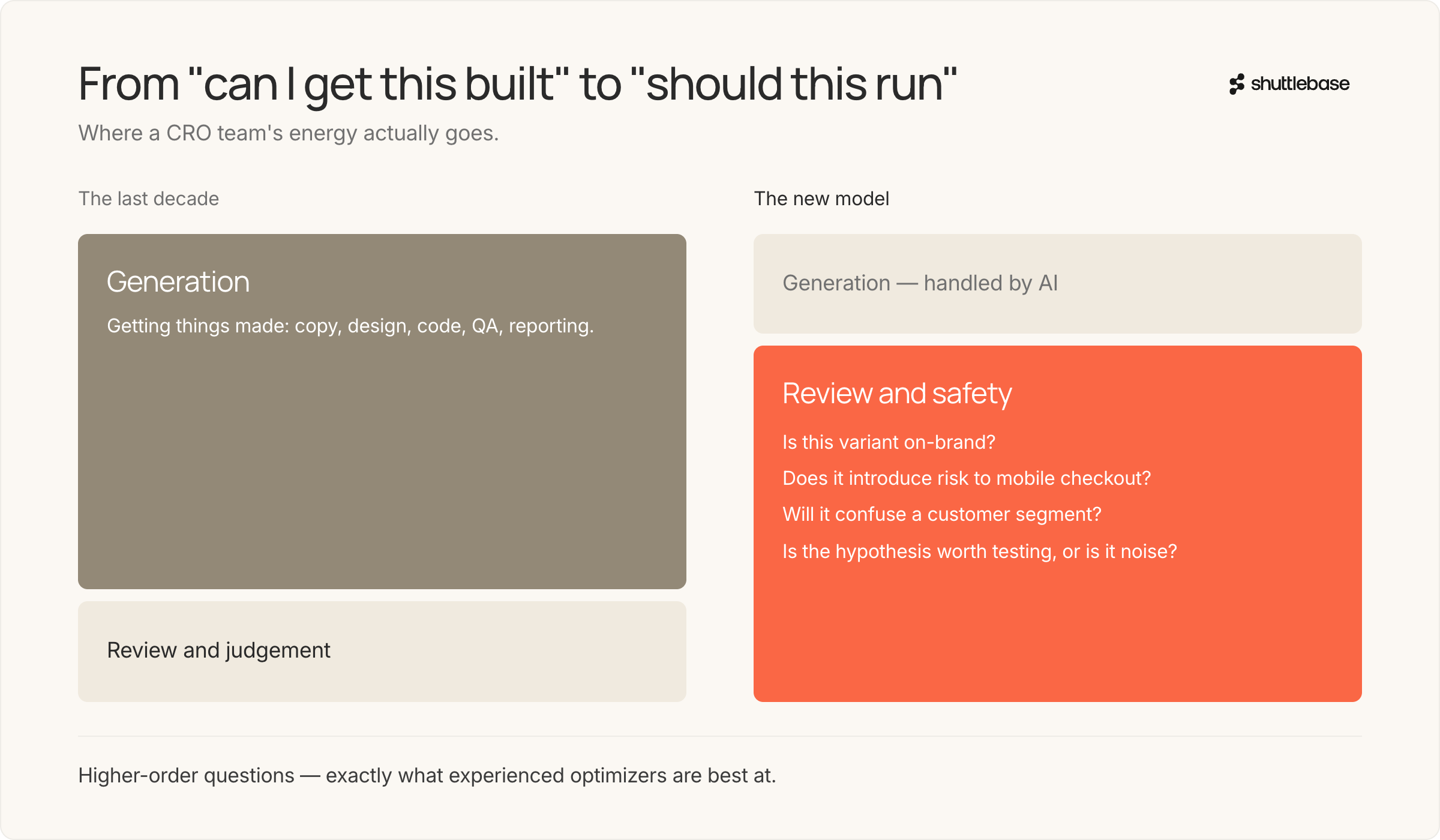
For the last decade, CRO teams spent most of their energy on generation - getting things created. The hard part was production. In the new model, generation is the easy part. AI handles it. The hard part becomes review and safety. Is this variant on-brand? Does it introduce risk? Could it break the mobile checkout? Will it confuse a specific customer segment? Is the hypothesis even worth testing, or is it noise? These are higher-order questions, and they are exactly the kind of judgment calls that experienced optimizers are best at. The skillset shifts from "can I get this built" to "should this run."
What This Means for Velocity
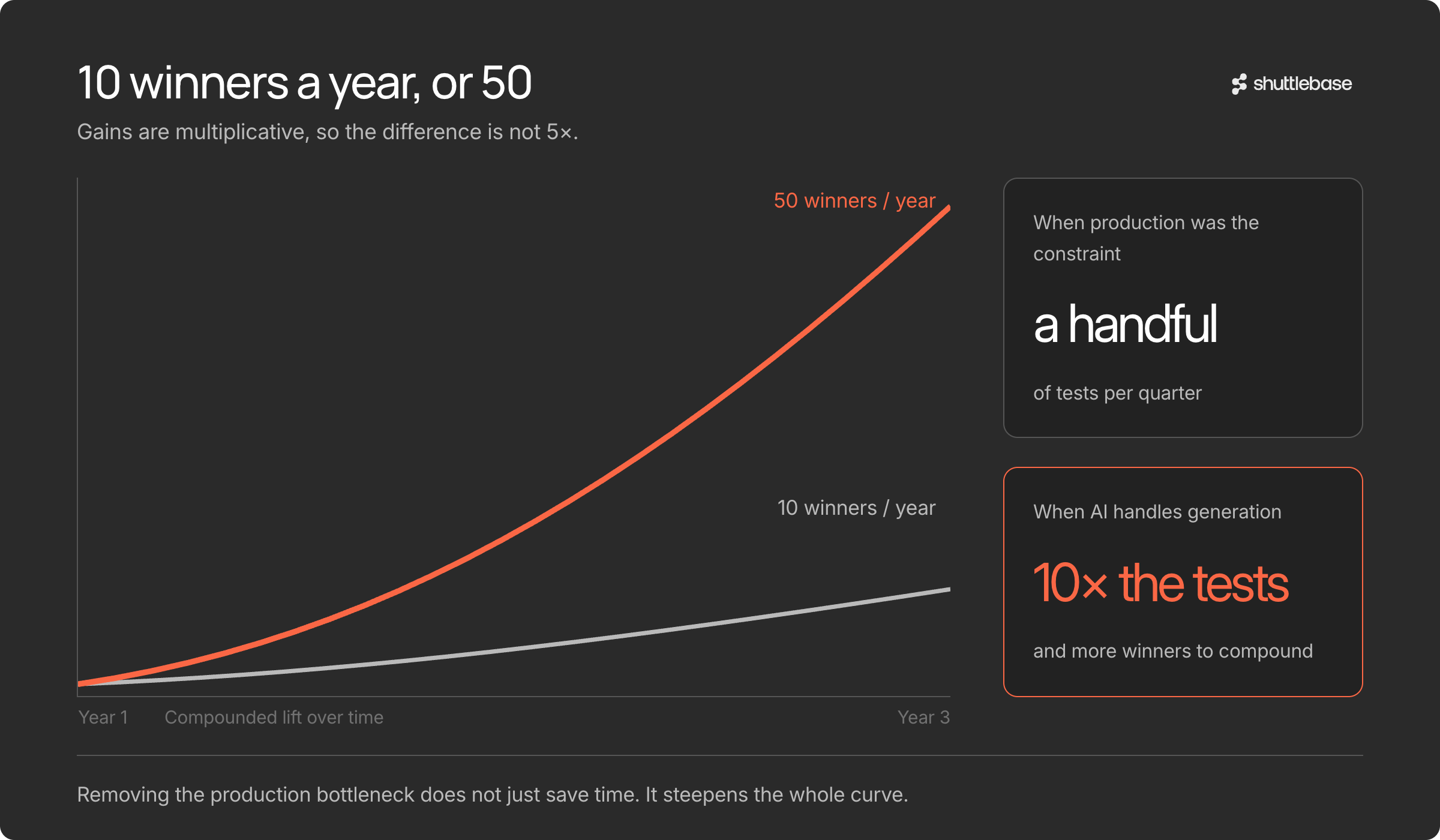
If you have read anything about how A/B testing compounds, you know that the number of winning tests you ship per year is the variable that matters most. When the constraint was production capacity, most teams managed maybe a handful of tests per quarter. When AI handles generation and platforms handle execution, that number climbs by an order of magnitude. More tests means more winners. More winners means faster compounding. And because the gains are multiplicative, the difference between shipping 10 winners a year and shipping 50 is not 5x. It is exponentially larger. Removing the production bottleneck does not just save you time. It steepens the entire growth curve.
This Is the Moment
The tools already exist. AI generates production-quality design and copy. Autonomous platforms run end-to-end experimentation. The generation problem, the one that has defined the pace of CRO for a decade, is being solved. The question is not whether this shift happens. It is whether you reorganize around it fast enough to capture the advantage. The teams that move first will compound faster, learn faster, and pull ahead in ways that are very hard to reverse. If you have ever sat in a sprint planning meeting fighting for developer time to ship a test you identified a month ago, you already know why this matters. That wait is almost over.