.jpg)
Share this article:
How Frequentist Testing Works
The Frequentist approach is the classical method taught in most statistics courses. It starts with a simple assumption called the null hypothesis: that there is no real difference between your control and your variation. The test then asks, "If there truly were no difference, how likely would I be to see data this extreme?"
That likelihood is the p-value. A p-value of 0.03 means there is a 3 percent chance of observing results this strong if the variation had zero real effect. Most A/B tests use a significance threshold of 0.05, meaning you reject the null hypothesis when the p-value drops below 5 percent. At that point, you declare the result "statistically significant."
Frequentist tests also require you to decide your sample size before the test begins. You choose a minimum detectable effect (the smallest improvement worth caring about), a significance level (usually 5 percent), and statistical power (usually 80 percent). A formula then tells you exactly how many visitors you need. The test runs until it hits that number, and only then do you look at the results.
A Simple Analogy for Frequentist Testing
Think of it like a courtroom trial. The null hypothesis is "innocent until proven guilty." The data is the evidence. The p-value measures how surprising the evidence would be if the defendant were truly innocent. You do not prove guilt beyond all doubt. You simply determine whether the evidence is strong enough to reject innocence at a predetermined standard. And critically, you must hear all the evidence before delivering the verdict. Checking partway through and making a ruling would compromise the entire process.
How Bayesian Testing Works
Bayesian testing flips the question. Instead of asking "how surprising is this data if there is no difference," it asks "given the data I have seen, what is the probability that one variation is better than the other?" That subtle shift changes everything about how the test operates.
Bayesian methods start with a prior - an initial estimate of what you expect to be true before seeing any data. This could come from previous tests, industry benchmarks, or simply acknowledging that you have no idea (called a non-informative prior). As data comes in, the prior gets updated into a posterior distribution, which represents your refined belief about the true difference between variations.
The output is a direct probability statement: "There is a 94 percent chance that variation B is better than the control." For many people, that is more intuitive than a p-value, which technically says something quite different.
A Simple Analogy for Bayesian Testing
Imagine you are a doctor diagnosing a patient. Before running any tests, you already have some belief about what is wrong based on the patient's symptoms and medical history. That is your prior. Each lab result updates your belief. After several results, your confidence in the diagnosis has shifted - it might have gotten stronger or weaker depending on what the data showed. You always work with the best estimate available, given everything you know so far.
What Each Approach Tells You (And What It Doesn't)
A Frequentist result tells you: "If there were no real difference, you would see data this extreme only 3 percent of the time." It does not tell you the probability that your variation is better. That distinction is subtle but important. The p-value describes the data's behavior under an assumption, not the probability that the assumption is true.
A Bayesian result tells you: "Given the data collected, there is a 94 percent probability that variation B outperforms the control." This is closer to what most people actually want to know. However, it depends on the prior you chose, and different priors can lead to different conclusions, especially with small sample sizes.
The Peeking Problem
One of the most practically important differences between the two approaches is what happens when you check your results before the test is scheduled to end.
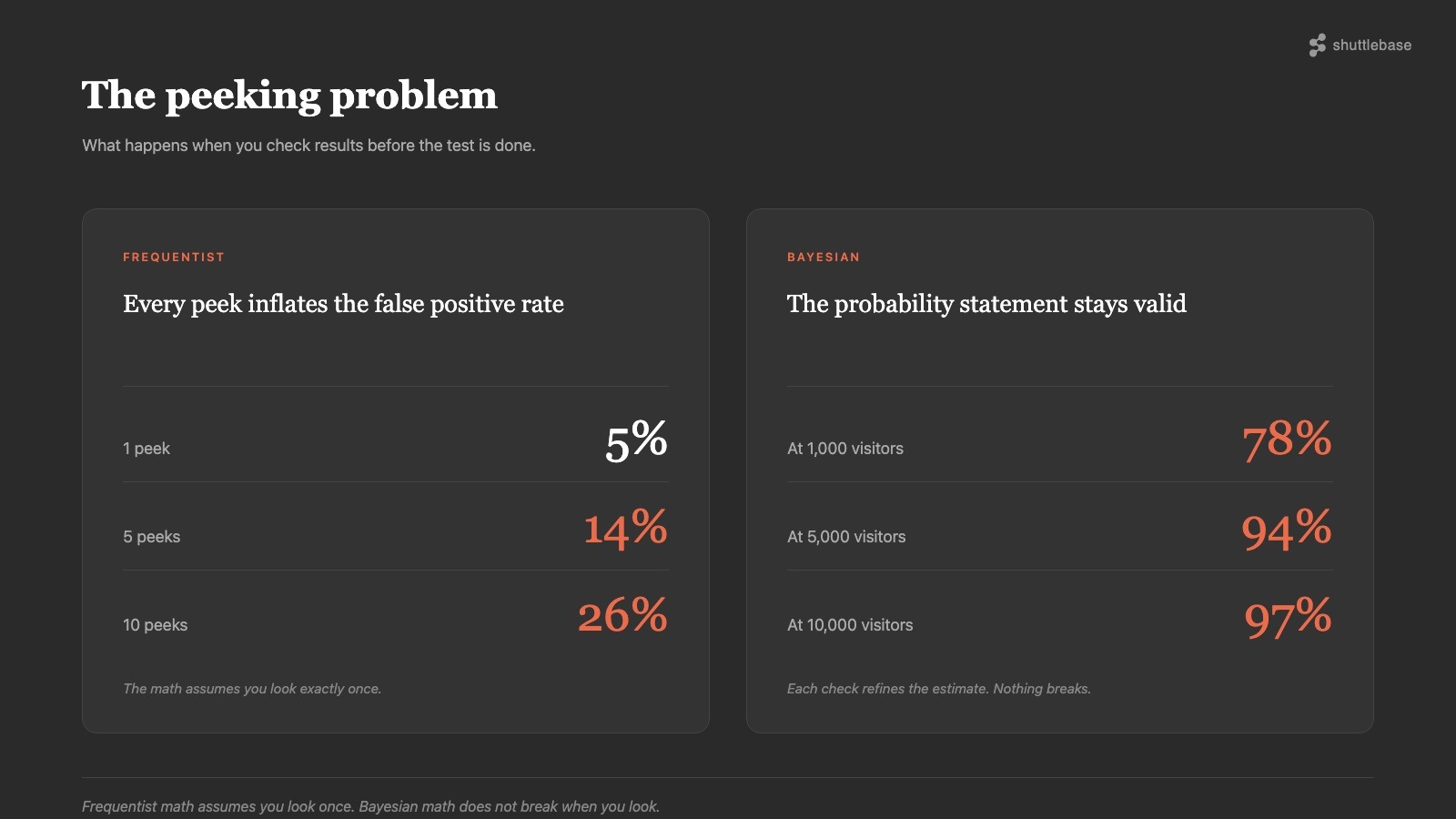
In Frequentist testing, the math assumes you will look at the results exactly once, at the predetermined sample size. Every time you peek at the data midway and consider stopping, you increase the chance of a false positive.
Bayesian testing continuously updates a probability distribution rather than relying on a fixed-sample-size calculation, so looking at the data early does not inflate error rates in the same way. You can check a Bayesian test at any point, and the probability statement remains valid for the data observed so far. This does not mean you should always stop early - small samples still produce wide, uncertain estimates - but the framework does not break when you look.
When Frequentist Testing Shines
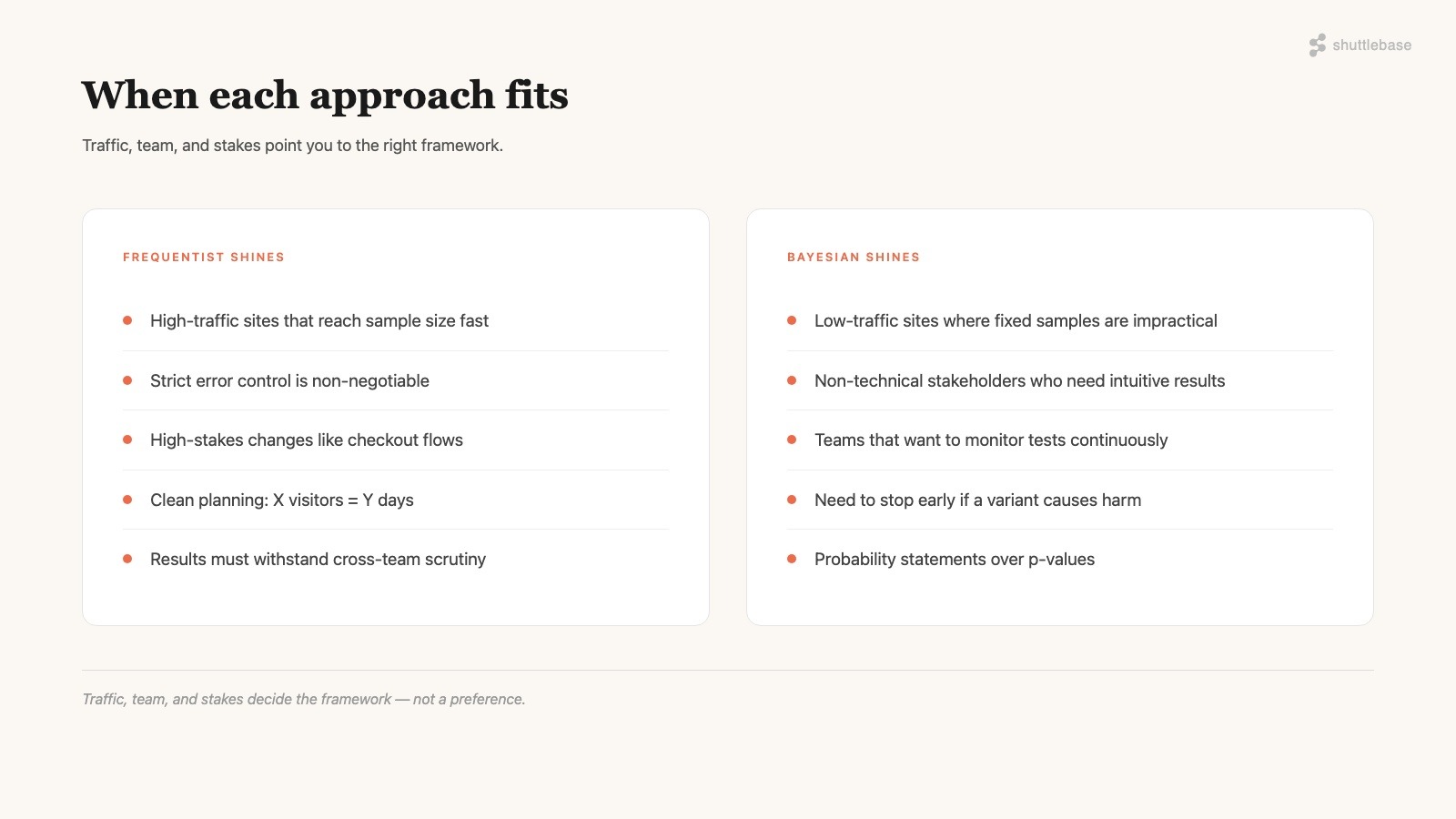
When you need strict error control, the Frequentist framework is hard to beat. You set your false positive rate (Type I error) and false negative rate (Type II error) before the test starts, and the math guarantees those rates hold as long as you follow the protocol. For organizations where a wrong decision is costly - think checkout flow changes on a high-revenue site - that guarantee has real value.
Frequentist tests are also straightforward to plan. The sample size calculation gives you a clear answer: you need X visitors, which at your traffic level will take Y days. That predictability makes it easier to schedule tests and manage stakeholder expectations.
Finally, Frequentist results require no prior assumptions about the data. The conclusion depends entirely on the experiment itself, not on beliefs brought in from outside. That objectivity matters when results must withstand scrutiny from multiple teams.
When Bayesian Testing Shines
For low-traffic sites, Bayesian testing can be more practical. Because it does not require a predetermined sample size, you are never told "you need 50,000 visitors per variation" when your site gets 2,000 a month. Bayesian methods will give you a probability estimate at any sample size - though the estimate will be wide and uncertain with small samples.
Bayesian results are also easier to communicate to non-technical stakeholders. "There is a 92 percent chance this variation is better" is more intuitive than "the p-value is 0.04, meaning there is a 4 percent chance we would see results this extreme under the null hypothesis." In organizations where leadership buy-in matters, that clarity has practical value.
Continuous monitoring is another Bayesian strength. Teams that want to check results daily without worrying about inflating error rates find Bayesian frameworks more forgiving. This is particularly useful for tests that might need to stop early because they negatively impact a key metric.
The Role of Priors
Priors are the element of Bayesian testing that generates the most debate. A prior is your starting assumption about the likely effect size before seeing any data. If you have run many similar tests before, you can use that history to set an informative prior. If you have no relevant background, you use a non-informative prior, which essentially says "I have no strong expectation."
The good news is that with large enough sample sizes, the prior matters very little. The data overwhelms it. Two analysts with very different priors will converge on nearly identical conclusions after seeing enough data. The risk comes with small samples, where a poorly chosen prior can pull the results in a misleading direction.
Sequential Testing: Bridging the Gap
The gap between these approaches has narrowed considerably. Modern Frequentist methods now include sequential testing procedures - techniques like alpha spending functions and group sequential designs - that let you peek at results at predefined checkpoints without inflating false positive rates.
These methods pre-allocate portions of your total error budget to each interim look. If you plan to check results at 25, 50, 75, and 100 percent of your target sample size, the method adjusts the significance threshold at each checkpoint so the overall false positive rate stays at 5 percent. It offers some of the monitoring flexibility of Bayesian testing while keeping the strict error guarantees of Frequentist methods.
Common Misconceptions
A few persistent myths deserve correcting.
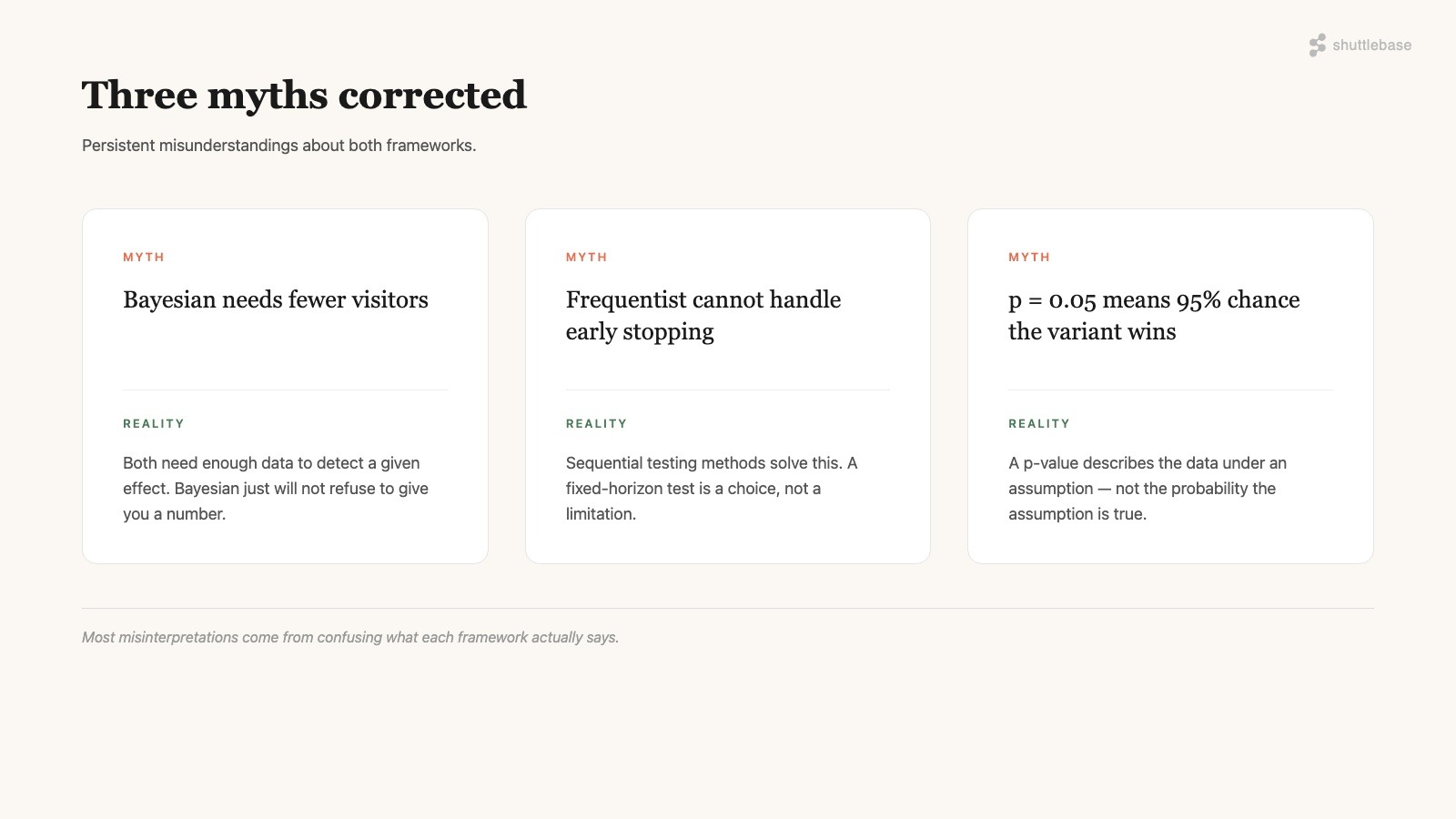
"Bayesian testing requires fewer visitors." Not necessarily. Both approaches need sufficient data to detect a given effect size. Bayesian tests will produce a result with any sample size, but that result may be too uncertain to act on. The sample size requirement is driven by the size of the effect you are trying to detect, not by the statistical framework.
"Frequentist testing cannot handle early stopping." This was true of the simplest implementations, but modern sequential testing methods address it directly. A strict, fixed-horizon approach to testing is a choice, not a framework limitation.
"A p-value of 0.05 means there is a 95 percent chance the variation is better." This is the single most common misinterpretation in A/B testing. A p-value describes the probability of the data given the null hypothesis, not the probability of the hypothesis given the data. That reversal is the core philosophical difference between the two frameworks.
Choosing the Right Approach for Your Team
No universal answer exists, but here are practical guidelines.
Consider your traffic volume. High-traffic sites can run clean Frequentist tests that reach significance quickly. Low-traffic sites may find Bayesian methods more practical for getting actionable (if less certain) results sooner.
Consider your team's statistical literacy. If your team is comfortable with p-values and confidence intervals, Frequentist methods work well. If your stakeholders repeatedly misinterpret statistical significance, Bayesian probability statements may reduce confusion.
Consider your testing velocity. If you run many tests in rapid succession and need to monitor continuously, Bayesian or sequential Frequentist methods reduce friction. If you run fewer, higher-stakes tests with clear timelines, classical Frequentist methods provide the strongest guarantees.
Consider your tool. If you are already committed to a platform, understand what statistical methods it supports and how it calculates results. Knowing whether your tool is Frequentist or Bayesian helps you interpret its output correctly and avoid the mistakes each framework invites.
The Bottom Line
Frequentist and Bayesian A/B testing are not competing religions. They are different tools for managing uncertainty, each with genuine strengths and real limitations. The best testing program is one where the team understands what their chosen framework actually says, what it does not say, and where its blind spots are. Knowing which method you are using and what conclusions you can draw from your data helps everyone in your organization understand and communicate wins and learnings.
The statistics behind your tests only matter if your team understands what they're actually saying. If you're not sure whether your current framework fits your traffic, your team, or your goals, or if your results keep getting misread, we can help you sort it out and build a testing program that produces results you trust. Get in touch!
.jpg)
.jpg)
.jpg)