Summary
- If you are evaluating alternatives to Optimizely, a key consideration is how much bandwidth your team has to continuously design, run and analyze tests that grow your revenue.
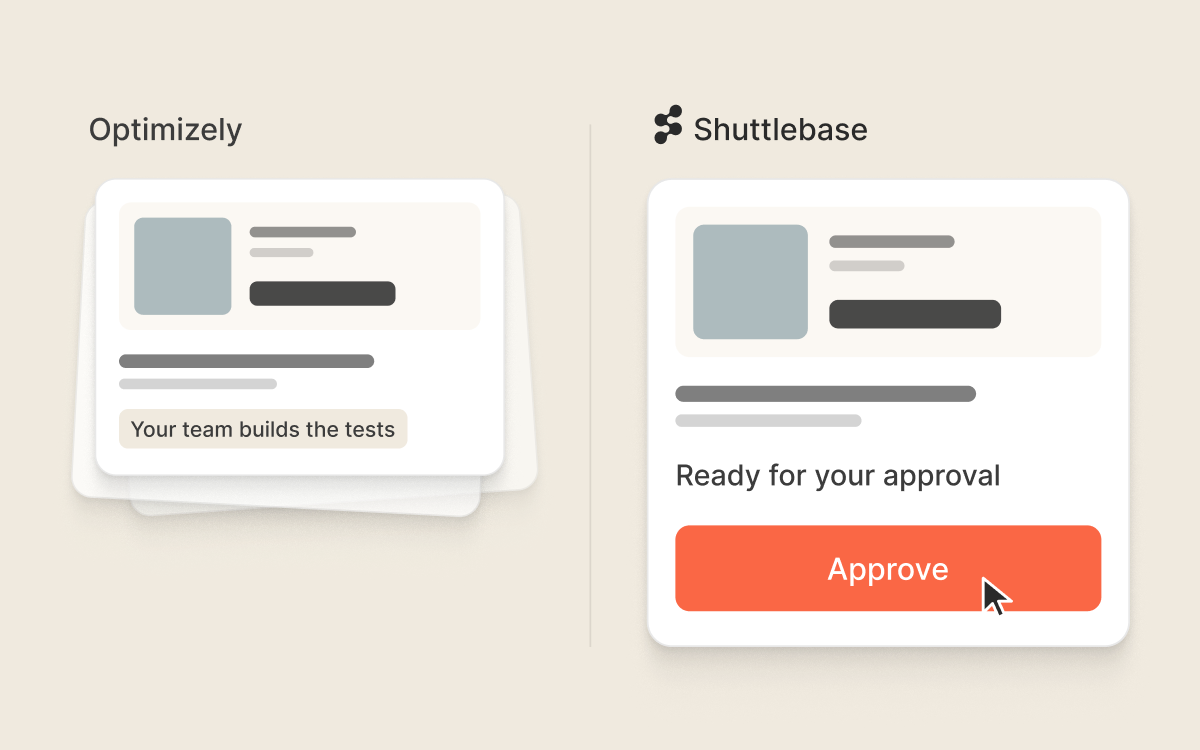
- For teams without that bandwidth, Shuttlebase is a full-cycle conversion rate optimization (CRO) platform: it recommends, builds and runs A/B tests, optimizing for revenue per visitor, not just conversions. It needs no design or development resources, and its median client gets a first winning test 26 days after the first test goes live.
- If your team comes up with its own test ideas but wants AI help, Kameleoon builds tests from your prompts, and Wingify's AI suggests what to test.
- If your team builds every test itself, Convert is the closest like-for-like switch.
- If you need strong visual editing, Shoplift is the best fit. If you mostly test prices and offers, look at Intelligems.
- If you'd rather not add a vendor, Shopify Rollouts runs A/B tests on Shopify's Grow plan or higher. If your developers build tests in code, GrowthBook is free and open source.
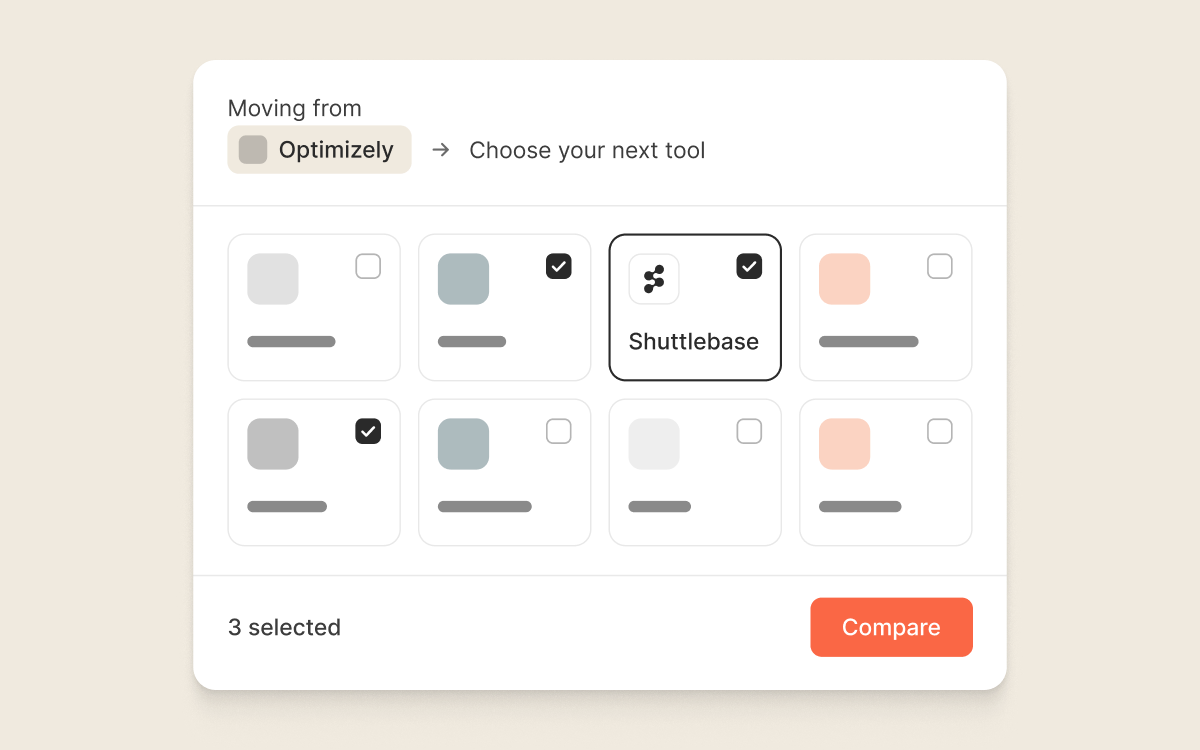
This guide compares Shuttlebase, Kameleoon, Wingify, Convert, Shoplift, Intelligems, Shopify Rollouts and GrowthBook. With most of them, your team still needs to come up with the test ideas, analyze the results, and often build the tests too. If your team doesn't have the bandwidth, look for a platform that does the work and asks for your approval before anything goes live.
The most important question is whether you need a testing tool or a full-cycle conversion optimization platform. A testing tool only helps you build and run A/B tests, and you supply the design, development and test ideas yourself. A full-cycle conversion optimization platform acts as a strategic partner: it analyzes your data, proposes the tests most likely to increase revenue, and handles design and development for you.
The alternatives at a glance
| Tool | Best feature | Who comes up with test ideas | Who builds the tests | Platforms |
|---|---|---|---|---|
| Optimizely (baseline) | Web, server-side and feature testing in one suite | Your team, with AI recommending what to test next | Your team | Any website, plus server-side |
| Shuttlebase | Fast test velocity (6 tests a month), tests ranked by revenue impact. AI that designs, builds and ships tests (with your approval) | Shuttlebase, from your store's data and tests on tens of thousands of other stores. Your team can add its own | Shuttlebase, launched with your team's approval | Shopify, Salesforce Commerce Cloud, BigCommerce, Magento, WooCommerce, headless and custom builds |
| Kameleoon | AI that builds tests from a prompt | Your team, with AI scanning pages for friction | AI, from your team's prompts | Any website, plus a Shopify app |
| Wingify (VWO and AB Tasty) | A broad suite: testing, heatmaps, session recordings and surveys | Your team, with the Wingz AI proposing hypotheses | Your team, with Wingz setting up tests | Any website, plus a Shopify app |
| Convert | Flexible statistics and server-side testing | Your team | Your team | Any website, plus a Shopify app |
| Shoplift | The best visual editor on Shopify | Your team | Your team, in the Shopify theme editor | Shopify only |
| Intelligems | Price, shipping and offer tests | Your team, with AI suggesting tests | Your team | Shopify only |
| Shopify Rollouts | Testing inside Shopify, with no new vendor | Your team | Your team | Shopify only |
| GrowthBook | Open-source feature and server-side tests | Your team | Your developers in code, or an AI visual editor on Pro | Your own code |
Why DTC brands leave Optimizely
Optimizely is a long-established testing platform, known for its visual editor, server-side control (changes made on your web server) and A/B, multi-page and feature testing. Reviewers on TrustRadius praise how easy it is to use, but many also point to how much work it takes to implement. These are the issues that come up when teams consider leaving.
- It needs analysts, designers and developers on staff. TrustRadius's summary of its reviews points to "technical complexity of implementation, often requiring significant custom coding and developer involvement". Even with an AI that recommends what to test next, someone on your team designs, builds and checks every test.
- Tests break when the site changes. Optimizely's own documentation says its targeting "breaks easily if the structure changes". A new template or product layout can stop a test from working until someone fixes it.
- Busy teams test less. How many tests you launch a month (your test velocity) depends on your team's bandwidth, and fewer tests means slower revenue growth.
- Security concerns. Security problems with Optimizely come to light from time to time. The most recent, in November 2026, put malicious code on the sites of hundreds of Optimizely customers. Optimizely closed the flaw the same day.
Criteria for evaluating a CRO platform
These 12 criteria matter most when you evaluate a testing platform for a DTC store. Use them to compare any tool in this guide, Shuttlebase included.
| Criterion | Why it matters | What to ask in a demo |
|---|---|---|
| Revenue per visitor (RPV) tracking | A great platform optimizes for the business metric behind your goal, most often a revenue uplift. It weighs conversion rate, average order value (AOV) and revenue per visitor together | Do you track revenue per visitor, or only conversions? |
| Results your team trusts | When a testing tool's numbers don't match your e-commerce platform or analytics, your team starts to doubt every result. Some gap is normal, because a testing tool counts only the shoppers in the test, as Intelligems explains | Which numbers do your reports use, and how close are they to what my store platform shows? |
| Conversion optimization beyond A/B testing | A great tool also offers landing pages for ad traffic, personalization and product recommendations | Besides A/B testing, what do you offer to optimize my site? |
| Time to first revenue uplift | The sooner the first tests go live, the sooner revenue starts to grow | How long until the first test is live, and how long until your clients see a revenue uplift, on average? |
| Test ideas recommended from data | Most e-commerce teams either run out of ideas to test or can't tell which of hundreds to pick. A system that predicts what works from your own data and other stores' test results raises the win rate | Does your platform generate test ideas? If so, what are they based on, and what is the win rate for the tests it proposes? |
| A clear hypothesis for every proposed test | A clear hypothesis and an explanation help your team learn from each test and judge which tests are likely to win next | Does each recommended test come with a hypothesis and the reason it might win? |
| A/B test win rate | The more tests win, the faster revenue grows. It matters most for stores with low traffic and high prices, where each test takes longer to reach a result | What is the win rate for tests run on your platform? |
| Test velocity: tests a month | Test velocity is higher when the platform builds the tests and no test waits on design or development | How many tests a month would you get live for a store like mine? |
| Website breaks | Tests and their targeting often break when the site changes, and can clash with other apps' code, such as Yotpo or Klaviyo. Fewer breaks mean more tests running at once | How often do tests break when a store changes? How do you keep tests and other apps from breaking each other? |
| Team hours to get one test live | Design and development time slow testing down | How many hours does a typical customer's team spend to get one test live? |
| E-commerce platform fit | A Shopify app runs only on Shopify. A snippet of code added to the site works on most platforms | Do you support my platform? |
| Security | As the November 2026 Optimizely incident showed, a breach in your testing platform can damage your website if the vendor doesn't run a solid security program | Does your platform run last-mile security checks? Do you run security checks from independent infrastructure? Is my data kept separate from other clients' data? |
Why revenue per visitor, not profit per visitor?
Profit per visitor subtracts what each order costs to make, ship and pack, so it is only as reliable as the cost data behind it, and most stores don't track all of it. Revenue per visitor counts both how many visitors buy and how much they spend, from data every store already has. That is why Shuttlebase optimizes for revenue per visitor.
The Optimizely alternatives
Shuttlebase: best for high-velocity, revenue-focused testing done for you
Shuttlebase is an AI conversion rate optimization (CRO) platform for e-commerce brands. It studies how visitors behave on your site, and the results of tests across tens of thousands of other stores, to find where revenue drops off. It ranks tests by how likely they are to win and how much revenue they could add. Then it builds them and launches each one your team approves, with no design or development work on your end. What sets Shuttlebase apart is that it handles both strategy and execution, from proposing tests that are most likely to generate revenue uplift to building and deploying them, always with your team's approval.
- Best for: DTC e-commerce brands such as beauty, apparel, retail and others that want to grow revenue per visitor without tying up designers or developers.
- Who comes up with test ideas: Shuttlebase, with a hypothesis for each test and the reason it expects the test to win. Your team can add its own ideas too.
- Who builds the tests: Shuttlebase. Your team reviews the tests, picks the ones to run and launches each with one click, without any coding.
- Platforms: Shopify, Salesforce Commerce Cloud, BigCommerce, Magento, WooCommerce, headless and custom builds, with one snippet of code added to the site and no product feed or API.
- Strengths:
- Optimizes for revenue per visitor, and the dashboard shows conversion, average order value and revenue side by side. Each result shows the chance the new version beats the original.
- Its test ideas draw on what comparable stores are testing right now and on past tests for brands like yours. There's no fixed list of changes it can test, and it can show where each idea came from.
- Tests rarely break when you change products or templates, because Shuttlebase keeps a current map of your store. That's why a store typically runs 4 to 8 tests at once, and some run as many as 50. Tests also work alongside Yotpo reviews, Klaviyo pop-ups and cart drawers.
- Also offers landing pages, personalization and product recommendations.
- Watch-outs:
- For the best visual (WYSIWYG) editor, look at Shoplift.
- Your store needs enough revenue and orders a month for tests to reach a result. If you get fewer than 200 orders a month, look at Shopify Rollouts.
- Against Optimizely: Shuttlebase recommends, builds and runs the tests with your team's approval. No dev resources are needed, so test velocity is much higher.
- 6 tests a month for the median active client, Shuttlebase client data.
- 26 days to the first win for the median client, counted from the first live test, 12 at the fastest. Shuttlebase client data.
- 35% of tests win on average. Clients report about 13% before Shuttlebase.
Larroudé ran more than 40 tests and got 7% more conversion in less than 4 months, with 10% more revenue per visitor (case study).

Kameleoon: best for AI that builds tests from a prompt
Kameleoon's AI scans your pages for friction and builds prioritized tests from your prompts.
- Best for: teams that run their own testing with an AI building the tests.
- Who comes up with test ideas: your team, with the AI pointing out friction on the page.
- Who builds the tests: the AI, from your team's prompts.
- Platforms: any website, plus a Shopify app that is free to install.
- Strengths: teams can create, launch, and measure experiments without relying on developers.
- Watch-outs: Kameleoon says developers should remain essential collaborators.
- Against Optimizely: a full platform with an AI that builds the variants.
Wingify (VWO and AB Tasty): best for a broad suite your team runs
VWO and AB Tasty announced they were joining forces as Wingify in January 2026.
- Best for: teams that run their own testing and want heatmaps, recordings and surveys in the same tool.
- Who comes up with test ideas: your team, with Wingz, an AI that proposes hypotheses.
- Who builds the tests: your team, with Wingz helping set them up.
- Platforms: any website, plus a Shopify app.
- Strengths: a visual (WYSIWYG) and code editor on the Growth plan, heatmaps, session recordings, funnels and surveys in the same platform, and multivariate testing.
- Watch-outs: the Shopify app tracks the store except checkout, post-purchase, and order status pages.
- Against Optimizely: a similar suite, with an AI proposing tests.
Convert: best for flexible statistics and server-side testing
Convert is the closest like-for-like switch for a team that keeps building its own tests.
- Best for: teams with designers and developers who build every test.
- Who comes up with test ideas: your team.
- Who builds the tests: your team, every test.
- Platforms: any website, plus a Shopify app.
- Strengths: customizable Frequentist and Bayesian stats engines and full-stack (server-side) testing.
- Watch-outs: your team still does all of the work.
- Against Optimizely: the same way of working, and Convert supports moving over from Optimizely.
Shoplift: best for visual editing on Shopify
With Shoplift, a marketer can make the change directly in the Shopify Theme Editor, and go live without a developer.
- Best for: marketers who build their own tests.
- Who comes up with test ideas: your team.
- Who builds the tests: your team, with Lift Assist to start a test from an on-brand section.
- Platforms: Shopify only.
- Strengths: winners go straight into your theme with nothing to rebuild, variants are flicker-free, rendered as the page loads, and Bayesian predictive analysis predicts how long each test needs to run. Price and subscription testing are listed as new.
- Watch-outs: your team builds every test.
- Against Optimizely: tests are built in the Shopify theme editor.
Intelligems: best for price, shipping and offer tests
Intelligems lets you test pricing and offers as well as content.
- Best for: brands that mainly test prices and offers.
- Who comes up with test ideas: your team, with Atlas, an AI that helps one operator uncover what's worth testing.
- Who builds the tests: your team, with Atlas helping build experiments faster.
- Platforms: Intelligems is built for Shopify and doesn't run on other platforms.
- Strengths: tests of shipping rates and free-shipping thresholds and of discounts, progress bars and gifts, with results framed around profit per visitor.
- Watch-outs: your team builds every test.
- Against Optimizely: narrower, and built around price and offer tests.
Shopify Rollouts and GrowthBook: best for no new vendor, or for tests your developers build
Shopify Rollouts can change your theme, checkout and product catalogs, and its A/B tests need the Grow plan or higher. Your team builds each change, and filtering results by device or country takes a query in ShopifyQL, Shopify's query language.
GrowthBook's code is open source, and the software is free to use. The hosted version is free for up to three users. Developers build most tests in code.
Pick by your reason for leaving
| If you're leaving Optimizely because | Look at | Why |
|---|---|---|
| Your team doesn't have the bandwidth to design, run and analyze tests | Shuttlebase | It recommends, builds and runs tests you approve |
| You want AI help with your own testing | Kameleoon or Wingify | Kameleoon's AI builds tests from your prompts, and Wingify's suggests what to test |
| You'll keep building tests and want flexible statistics | Convert | Frequentist and Bayesian engines, server-side testing |
| You want the best visual editor on Shopify | Shoplift | Tests are built in the theme editor |
| Prices and offers are what you test most | Intelligems | Price and offer tests |
| You want no new vendor | Shopify Rollouts | A/B tests included on the Grow plan or higher |
| Your developers run feature and server-side tests | GrowthBook | Open source and free to start |
| You are not on Shopify | Shuttlebase, Kameleoon, Wingify or Convert | They work on most platforms |
How to switch off Optimizely
- Run the new tool alongside Optimizely. Save your baseline (revenue per visitor, conversion and order value), and give each tool its own pages. Shuttlebase starts with a free audit and proposes the first tests for your store, each with its hypothesis, before you commit. The first tests can go live within 72 hours of install.
- Compare results against the baseline. Note the promotions and seasonal periods behind both.
- Cut over before renewal. Check the notice period in your contract, then remove Optimizely's code from your site.
Common questions
What are good Optimizely alternatives for a mid-size ecommerce brand?
Start with how much bandwidth your team has, then your platform. If you want the testing done for you, look at Shuttlebase, which asks for your approval before any test goes live. If your team builds its own tests, Convert is the closest to Optimizely, Wingify and Kameleoon add AI help, and Shoplift and Intelligems suit a Shopify store.
Is there a free alternative to Optimizely?
Yes. As open-source software, GrowthBook is free to use, and developers build each test. Shopify includes A/B tests in Rollouts on the Grow plan or higher.
Can a store with modest traffic still run A/B tests?
Yes. With modest traffic each test takes longer to reach a result, so a high win rate matters more. Shuttlebase works with stores of modest traffic, but turns away stores whose revenue and orders are too low for tests to reach a result.
Can you replace Optimizely without a CRO team?
Yes, with a platform that builds and runs the tests. DefenAge, with two people on the work and no big CRO team, got 14% more conversion, 14% higher average order value and 30% more revenue per visitor, and $600,000 in revenue uplift over 12 months with Shuttlebase.
Is it safe to keep a testing tool on your store after the Optimizely incident?
It can be, if the vendor checks every change. Optimizely says it closed the flaw and removed the harmful code. For any tool, ask who can change the code on your pages and whether every change is checked before customers see it.
Which Optimizely alternative fits
- Shuttlebase is well suited if you want tests recommended, built and run for you on Shopify, Salesforce Commerce Cloud, BigCommerce, Magento, WooCommerce or a headless or custom build, live only once you approve.
- Convert is well suited if your team builds and runs every test itself, and Kameleoon or Wingify if it wants AI help along the way.
- Shoplift is well suited if you are on Shopify and want to build tests in a visual editor.
- Intelligems is well suited if you are on Shopify and mainly test prices and offers.
About this comparison. Shuttlebase publishes this page and works to keep it accurate and current. Everything it says about other tools comes from their own public pages and documentation, review sites and public discussions, read between 18 and 24 November 2026. The page is reviewed every quarter and after major news. If anything here is out of date or inaccurate, contact Shuttlebase at shuttlebase.com/contact and it will be corrected.
Sources
- "Shuttlebase: AI conversion rate optimization for e-commerce", Shuttlebase, https://shuttlebase.com/ (read 2026-11-19)
- "Optimizely Agentic Experimentation", Optimizely, https://www.optimizely.com/products/experimentation (read 2026-11-18)
- "Plans and pricing", Optimizely, https://www.optimizely.com/plans/ (read 2026-11-18)
- "A/B testing for React applications and Gatsby", Optimizely Web Experimentation docs, https://docs.optimizely.com/web-experimentation/docs/ab-testing-for-react-applications-and-gatsby (read 2026-11-20)
- "Target dynamic selectors", Optimizely Web Experimentation docs, https://docs.optimizely.com/web-experimentation/docs/QJ28-target-dynamic-selectors (read 2026-11-20)
- "Optimizely Web Experimentation Reviews", TrustRadius, https://www.trustradius.com/products/optimizely-web-experimentation/reviews (read 2026-11-18)
- "Web Experimentation Security Incident", Optimizely status page, https://status.optimizely.com/incidents/ftw0fh9wx43z (published 2026-11-17, read 2026-11-18)
- "Ad Tech Company Optimizely Targeted in Cyberattack", SecurityWeek, https://www.securityweek.com/ad-tech-company-optimizely-confirms-cyberattack/ (published 2026-02-25, read 2026-11-20)
- "World's Largest Brands Infected With Malware Via Optimizely", Report URI, https://blog.report-uri.com/worlds-largest-brands-infected-with-malware-via-optimizely/ (published 2026-11-16, read 2026-11-18)
- "Why don't my A/B test orders match Shopify?", Intelligems, https://www.intelligems.io/resources/blog/why-dont-my-ab-test-orders-match-shopify (read 2026-11-24)
- "Larroudé case study", Shuttlebase, https://shuttlebase.com/case-studies/larroude/ (read 2026-11-19)
- "DefenAge case study", Shuttlebase, https://shuttlebase.com/case-studies/defenage/ (read 2026-11-19)
- "Kameleoon homepage", Kameleoon, https://www.kameleoon.com/ (read 2026-11-18)
- "Plans", Kameleoon, https://www.kameleoon.com/plans (read 2026-11-18)
- "Kameleoon A/B Testing", Shopify App Store, https://apps.shopify.com/kameleoon-abtesting-app (read 2026-11-19)
- "VWO and AB Tasty join forces", Wingify, https://wingify.com/blog/vwo-and-ab-tasty-join-forces/ (published 2026-01-20, read 2026-11-18)
- "Wingify, Digital Experience Optimization", Wingify, https://wingify.com/ (read 2026-11-18)
- "Pricing and Plans", Wingify, https://wingify.com/pricing/ (read 2026-11-18)
- "Shopify Integration", Wingify (VWO), https://vwo.com/integrations/shopify/ (read 2026-11-19)
- "VWO homepage", Wingify (VWO), https://vwo.com/ (read 2026-11-19)
- "Insights", Wingify (VWO), https://vwo.com/insights/ (read 2026-11-19)
- "Convert homepage", Convert, https://www.convert.com/ (read 2026-11-18)
- "Shoplift homepage", Shoplift, https://www.shoplift.ai/ (read 2026-11-18 and 2026-11-19)
- "Pricing", Shoplift, https://www.shoplift.ai/pricing (read 2026-11-18 and 2026-11-19)
- "Intelligems homepage", Intelligems, https://www.intelligems.io/ (read 2026-11-18 and 2026-11-19)
- "Pricing", Intelligems, https://www.intelligems.io/pricing (read 2026-11-18)
- "Types of rollouts and changes", Shopify Help Center, https://help.shopify.com/en/manual/markets/rollouts/rollout-types (read 2026-11-19)
- "Requirements and considerations for using rollouts", Shopify Help Center, https://help.shopify.com/en/manual/markets/rollouts/requirements-and-considerations (read 2026-11-19)
- "Rollout analytics", Shopify Help Center, https://help.shopify.com/en/manual/markets/rollouts/analytics (read 2026-11-19)
- "GrowthBook homepage", GrowthBook, https://www.growthbook.io/ (read 2026-11-18)
- "Pricing", GrowthBook, https://www.growthbook.io/pricing (read 2026-11-18)
- "GrowthBook Docs", GrowthBook, https://docs.growthbook.io/ (read 2026-11-19)