I love my job. I love it because in addition to building really cool sh!t on the product side, Shuttlebase is still a small company grounded in ownership. In practice, this means that I get to sit on countless sales and client calls every week.
To some engineers, this level of face-to-face contact with the outside world could be a serious downside. I, however, am a huge fan. I have always firmly believed that the way to make sure that you are building the right stuff as a company is to have everyone on the team intimately burdened by the problems of our clients and prospects. Issues we own, that irk us and keep us up working late are the fastest and easiest and most motivating to solve.
All of that preamble to say, I have spent a lot of time meeting with potential customers this week, and I wanted to take a few minutes to share what I see as the scale of sophistication in their usage of AI.
Every time I get on one of these calls with either our CEO or a member of our GTM team, I am completely unprepared for the person on the other side of the call. Because in a market that's changing so quickly, it's genuinely impossible to predict what the other party's experience is with AI tools based on their title. I have met with engineers who do not use AI tools at all, and growth marketers who ask me wildly detailed questions about our underlying models. It's psychologically thrilling.
That experience has inspired me to write this guide on understanding where you and your organization or team stand in the grand scheme of things as seen through my eyes. No place on this spectrum is bad, and it is of course a very organization-specific decision: at what pace to adopt and integrate all the potential tools and use cases that AI has to offer. I write only to level set based on what I have seen, and to provide the beginning of a roadmap for achieving the next set of results and moving towards the forefront of the AI revolution based on where you self-diagnose your team to be at today.
Quick author note: our clients are largely DTC ecommerce brands; however, I hope these thresholds and prescriptions are widely applicable across industries and teams.
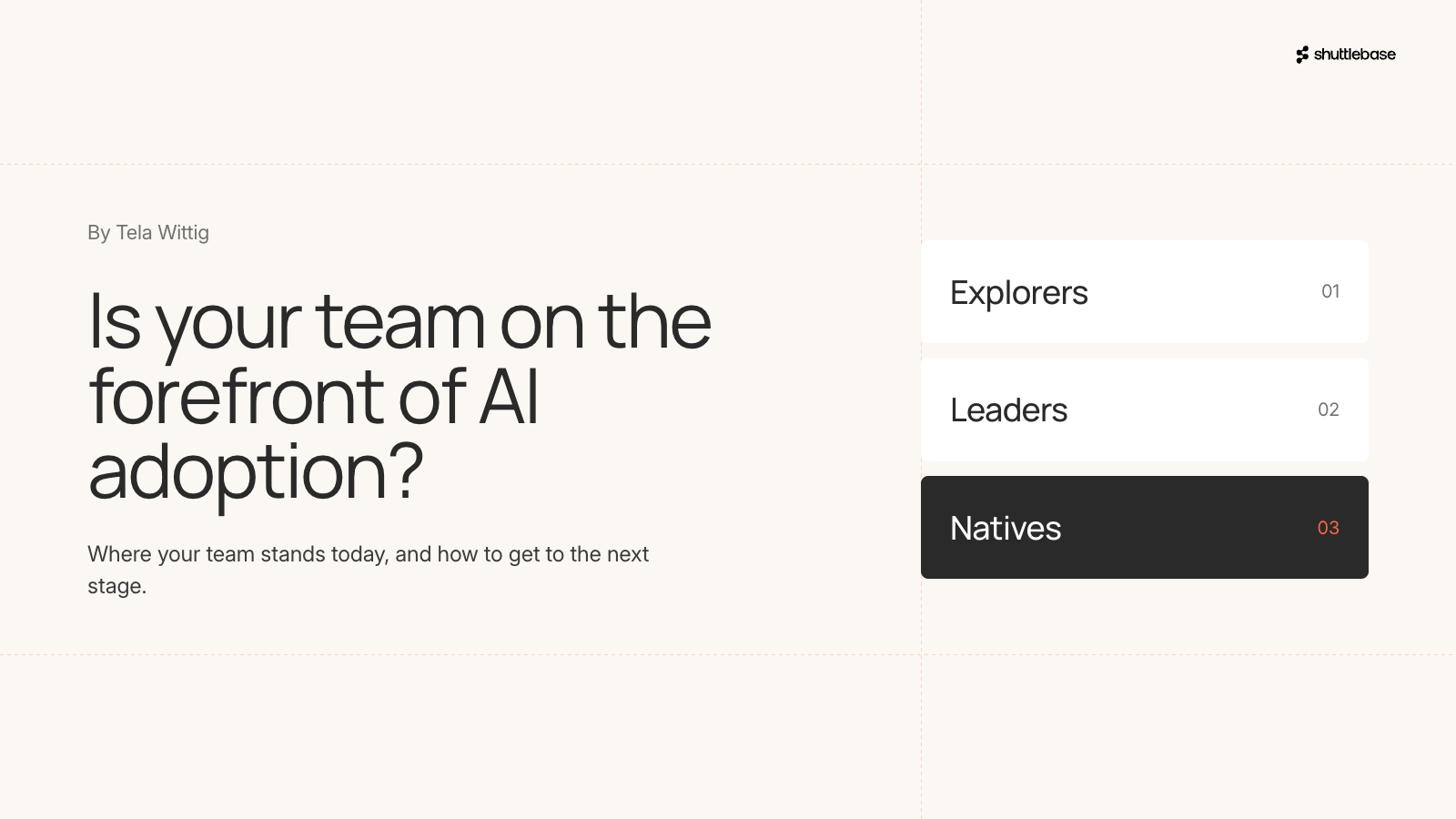
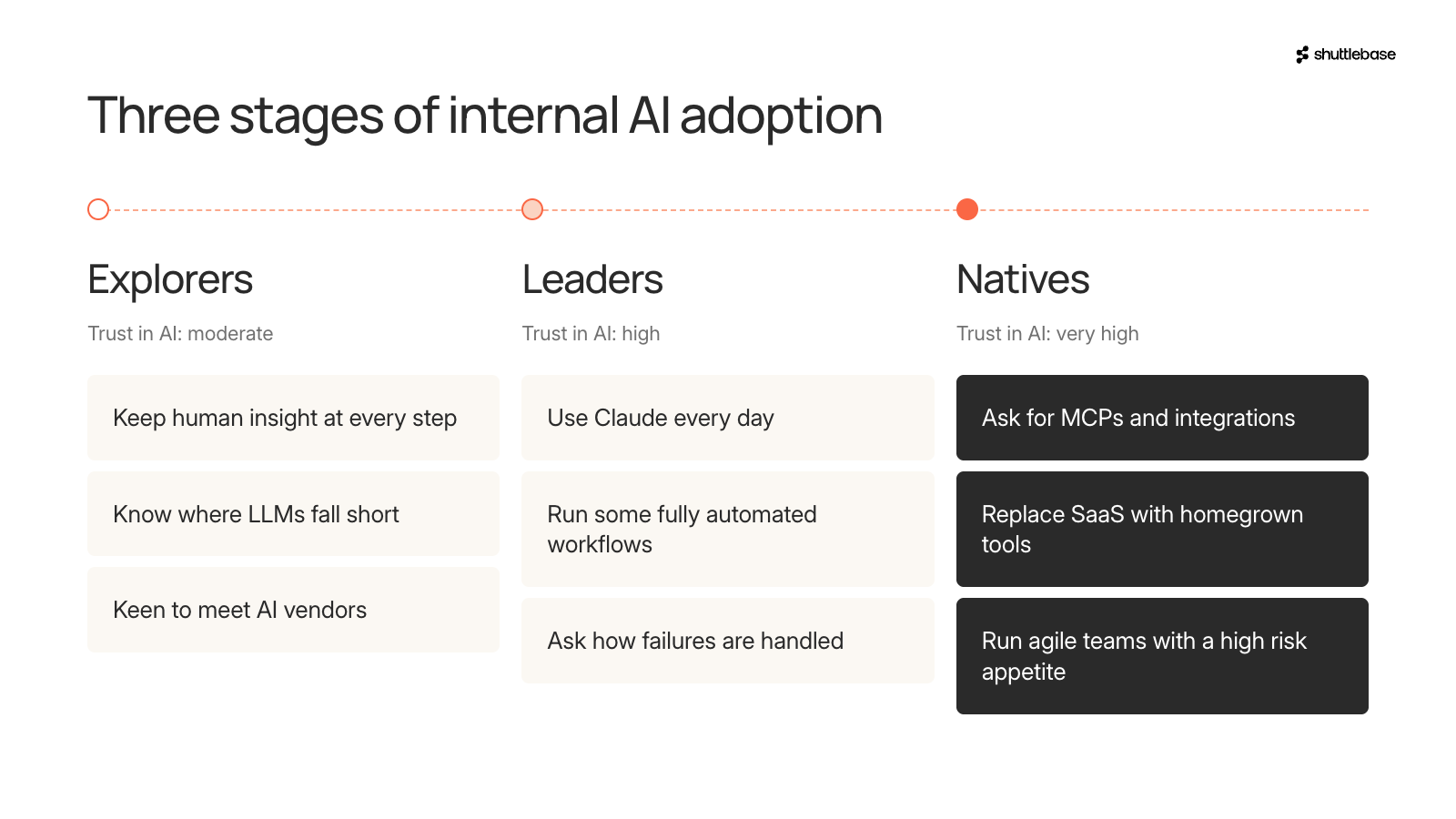
For brevity purposes, I'm going to break the levels of internal AI adoption into 3 main groups: Explorers, Leaders, and Natives.
Let's start with Explorers.
As an AI-driven company, we rarely speak with anyone who isn't at least contemplating the use of AI tools to make their daily jobs easier. When we meet with Explorers, we generally find that they are highly motivated to engage with vendors who are offering AI solutions. They have an understanding of how LLMs work, where their limitations are, and what they're really good at. They are firm believers that the current limitations of LLMs ensure that human insight at every step is still the right path of action, and they have a moderate level of trust in the AI-driven systems they leverage today.
Leaders, on the other hand, have higher trust in their systems and have built manual processes around them to support the safe use of AI. They rely on Claude desktop daily, likely have workflows that are fully automated using AI, and may be using Claude Cowork or specific Claude/Codex skills to perform certain job functions. They have spent enough time playing with their tools to ask questions about the failure handling mechanisms that ensure safety for the tool in practice. Leaders really get it; they are ready and excited to partner with new tools, and their rapid adoption optimizes the impact that tools like us are able to make for their organizations.
Natives are a whole different breed. Natives have fully drunk the AI automation Kool-Aid and reformed their entire workflow to include or be replaced by LLMs. They are identified by a very high level of trust in these systems and a workflow and tool usage that makes them speak in AI-centric jibberish. Natives often ask us for integration components like MCPs and are keen to differentiate any new tool from Claude, as they are intimately aware of their capabilities and limitations and can imagineer our solution to the point of anticipating its limitations all on their own. Natives are likely to have cancelled tools and SaaS in the past year or so as they realized how easy it was to build a homegrown tool or process to replace so many of their previous providers. Natives are awesome rockstars who speak fluent geek and are leading the charge for their company, usually with an incredibly agile team that has a sky-high risk appetite.
We love working with companies who identify as any of the above, and where you land is bound to be informed by the company, team, position, and culture in which you find yourself. There is nothing wrong with remaining a Leader forever; some brands are too sensitive to risk to tolerate the unpredictability of the native approach. However, if you and your team are interested in moving towards the forefront of the AI revolution in incremental ways that your organization can stomach, consider this your roadmap.
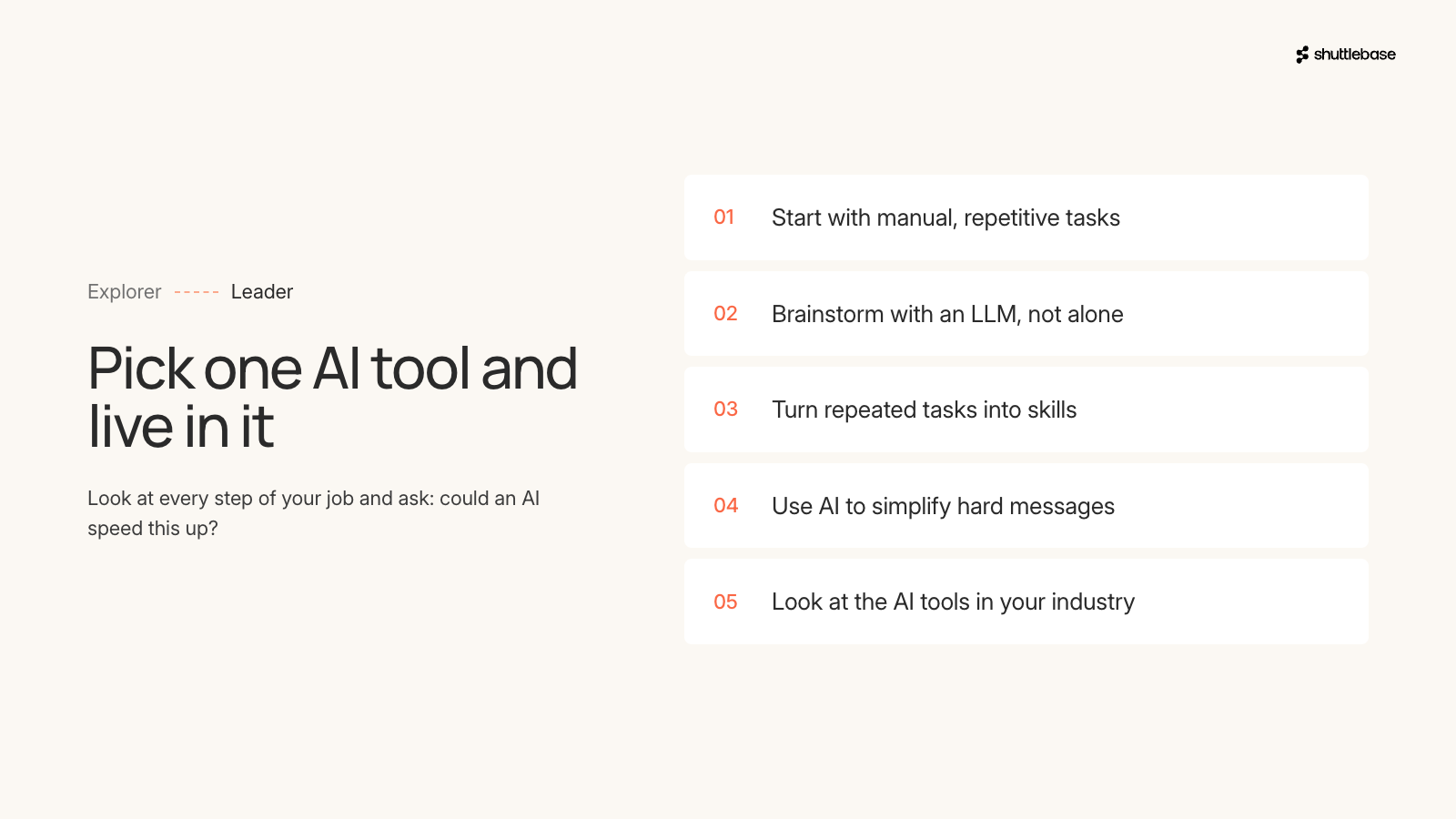
How Explorers become Leaders
The single biggest thing you can do is get deeply intimate with one AI tool, and I mean pick one and live in it. Claude is a great place to start. Start evaluating every step of your job through the lens of "could an AI speed this up?" The tasks that tend to be the best fit are the ones that are incredibly manual, or the ones where you need a small structured output from a large corpus of information. Think: summarizing a 40-page report into three bullets, reformatting data, drafting an initial version of a document you were going to write from scratch anyway.
From there, start brainstorming solutions to problems alongside an LLM rather than alone or with just your team. You will be surprised how good the output is when you treat these conversations as a back-and-forth rather than a single prompt. For tasks you find yourself repeating, ask Claude to create a skill so it remembers what the task was and how to do it again next time. Use it to simplify complex communications: that email you've been agonizing over, that Slack message to leadership, that customer response where the tone has to be exactly right. And take time to investigate the AI tools that exist today across your industry. There is almost certainly a tool addressing every major business problem you face, and many of them are further along than you'd expect.
How Leaders become Natives
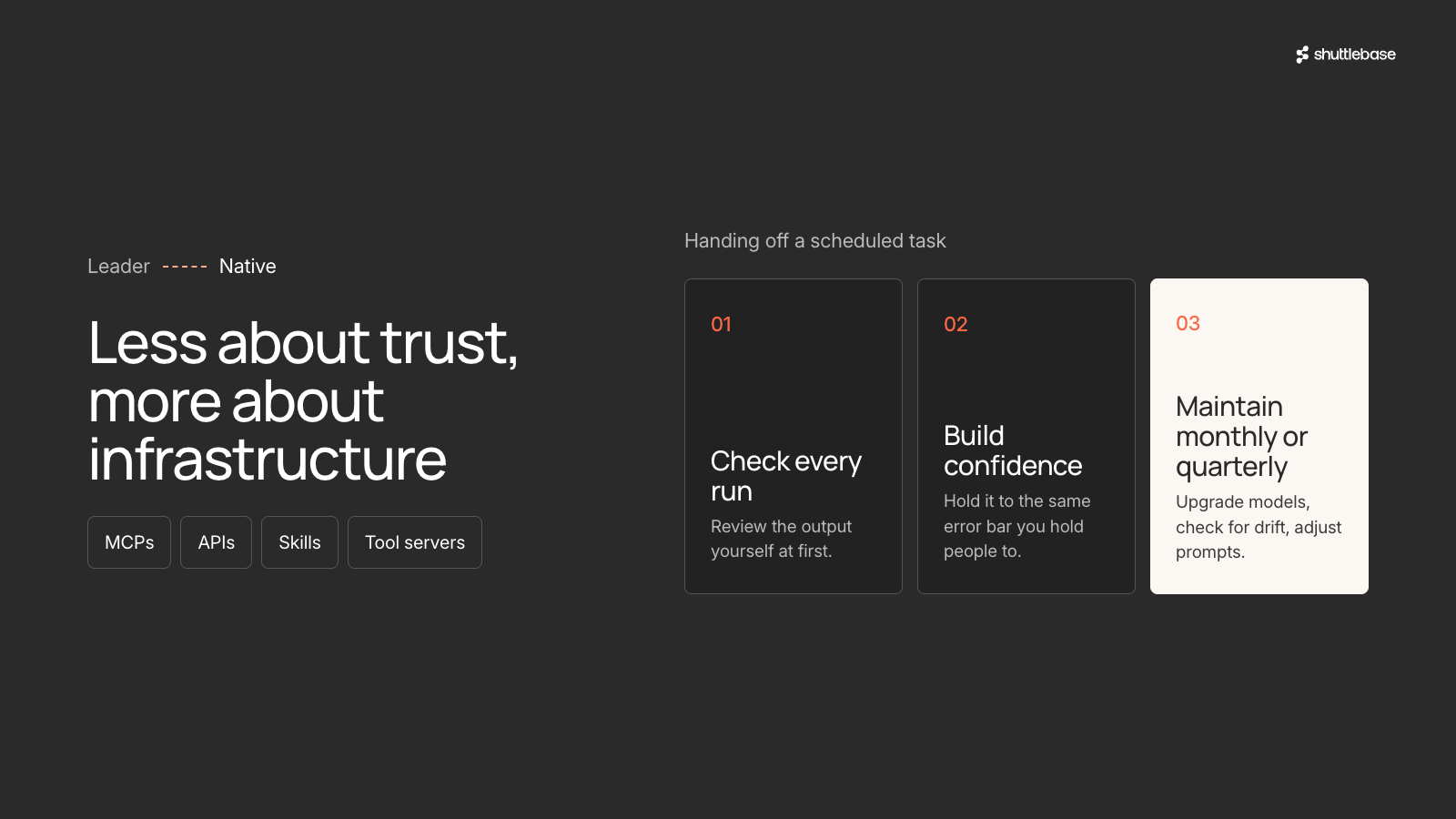
The jump from Leader to Native is less about trust and more about infrastructure. Get up to speed with MCPs, APIs, skills, and tool servers. These are the connective tissue that lets AI tools talk to each other and to your existing systems, and understanding them is what separates someone who uses AI from someone who builds with it. Start sharing artifacts from Claude with other members of your organization. A prompt that works well for you probably works well for your colleague doing similar work, and that kind of cross-pollination accelerates adoption faster than any mandate from leadership.
Set up scheduled tasks to run for you. Check the output manually at first, but only until you've built confidence in the system. Then transition to monthly or quarterly maintenance: upgrading models, verifying that performance hasn't degraded, and adjusting prompts as your business changes. Begin onboarding automation tools that operate without your direct oversight. This is the hardest psychological leap, but it's where the real leverage lives.
Spend time with your team thoroughly understanding their job functions so you can help identify optimization opportunities together. The people closest to the work are the ones who know where the bottlenecks are; you just need to help them see those bottlenecks as solvable with the tools you now understand. Find and integrate tools like humanizer and other skills that make LLM-written materials easier to read and pass as genuinely human. And honestly evaluate your threshold for human error in day-to-day processes, then hold that same expectation for automated systems. They will not be perfect, but the question is whether they are acceptably flawed, and the answer is usually yes at a bar that's lower than you think.
How Natives weather the challenges ahead
If you've made it to Native, congratulations: you're operating at a level that most organizations won't reach for years. But the frontier comes with its own set of risks that deserve your serious attention.
Consider the security implications at scale. Sit down with engineers and security experts and map out where the weaknesses in your system are and what happens if they're exploited. AI tools touch a lot of sensitive data and have access to a lot of surface area, and the attack vectors are not always obvious. Ask yourself what happens to your business if Claude goes down for a day. Are you crippled, or have you built enough organizational redundancy to keep operating? If the answer makes you uncomfortable, that's a gap worth closing before it closes itself.
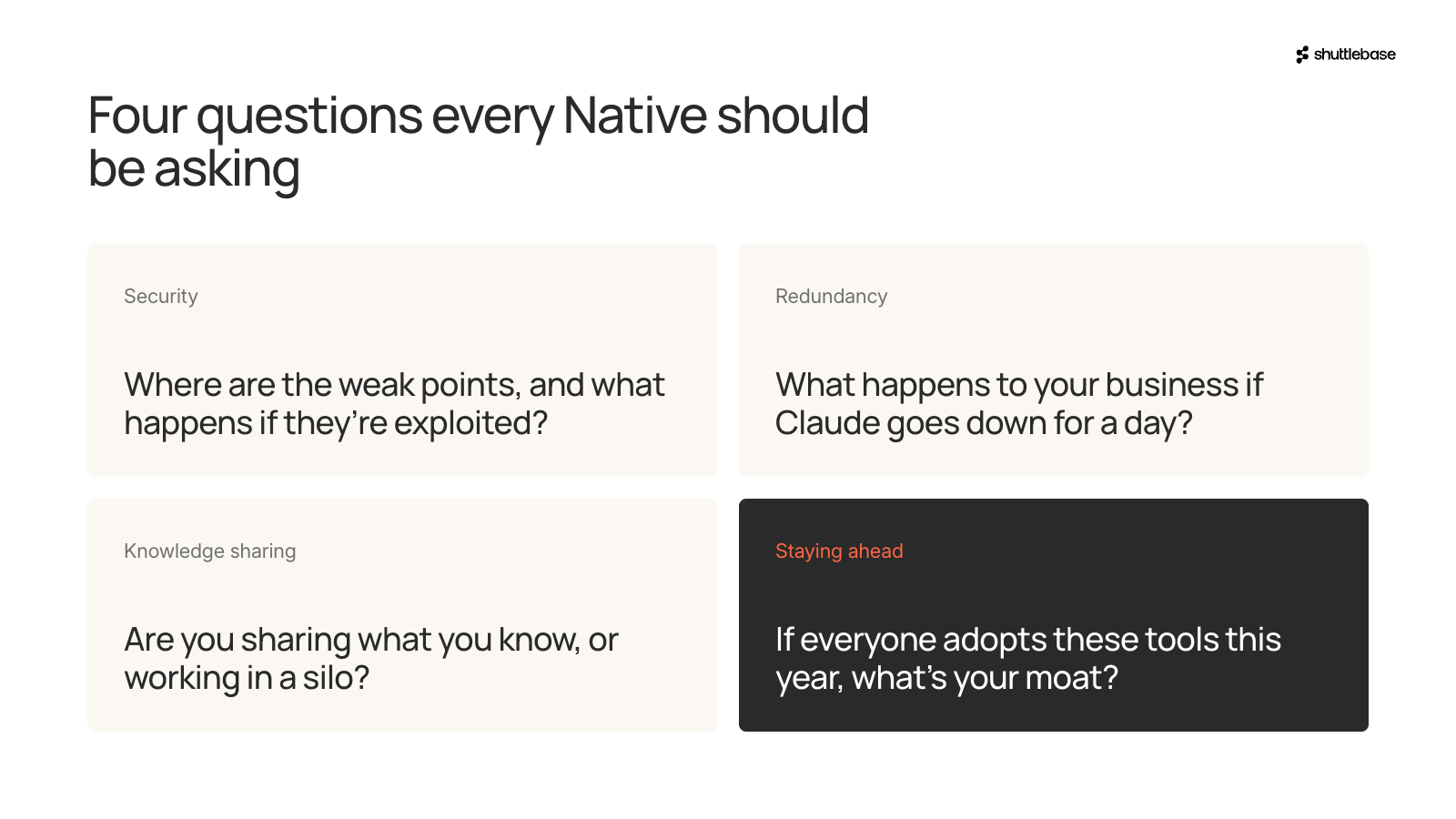
Think about whether you're lifting others up with you. Are you sharing your expertise with industry colleagues and other teams at your organization, or are you operating in a silo that could become a liability the moment you're unavailable? Has leadership been kept on board? Do they understand the impact these tools are having and the real cost-benefit picture, not just the productivity gains but the dependencies you've introduced?
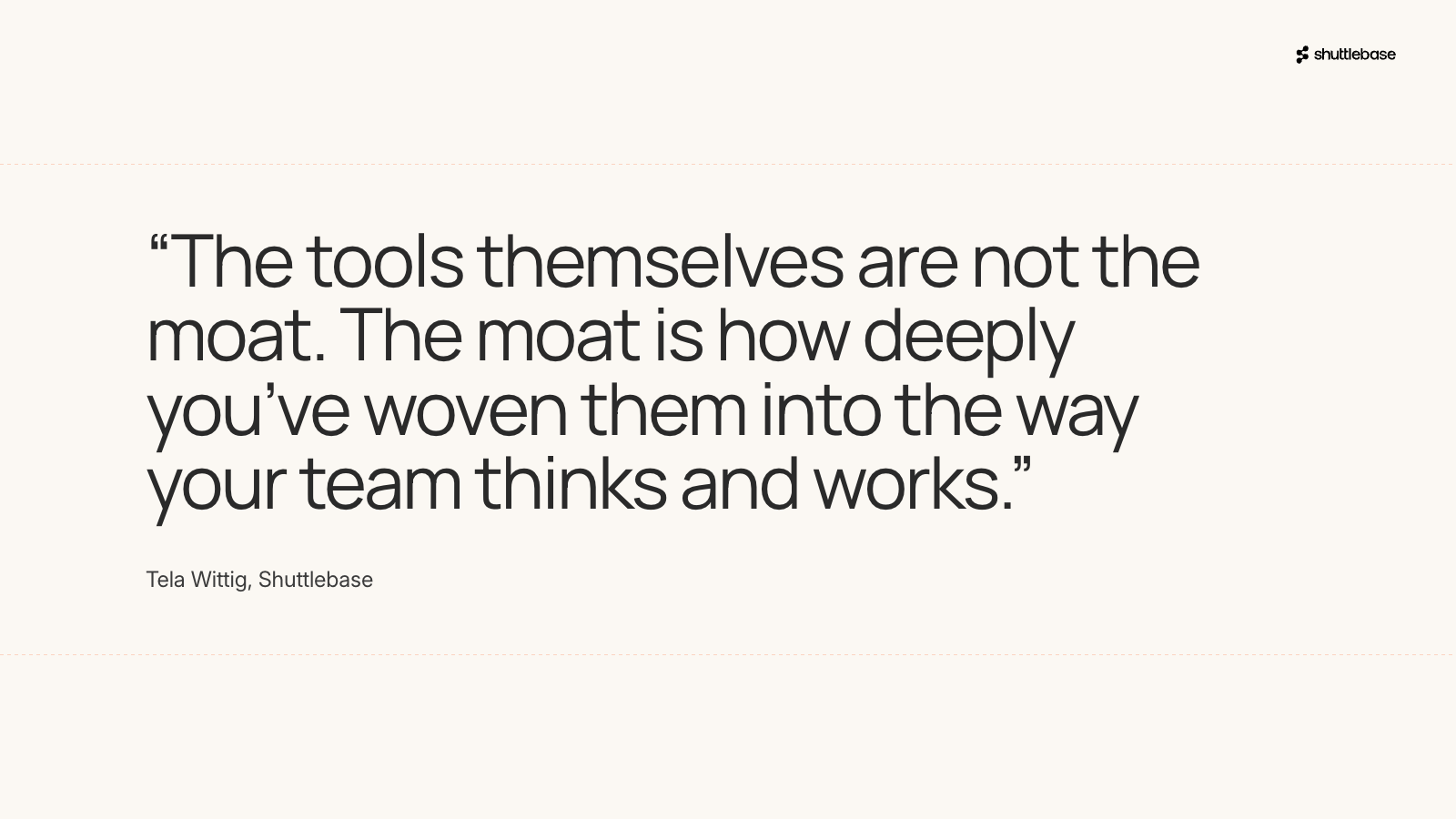
And finally, the hardest question: how do you stay ahead? If the rest of your industry adopts these tools and practices this year, how do you keep your edge? Have you built a moat, a depth of integration, a speed of iteration, a quality of output, that keeps others far behind? The tools themselves are not the moat. Everyone will have them. The moat is how deeply you've woven them into the way your team thinks and works.